
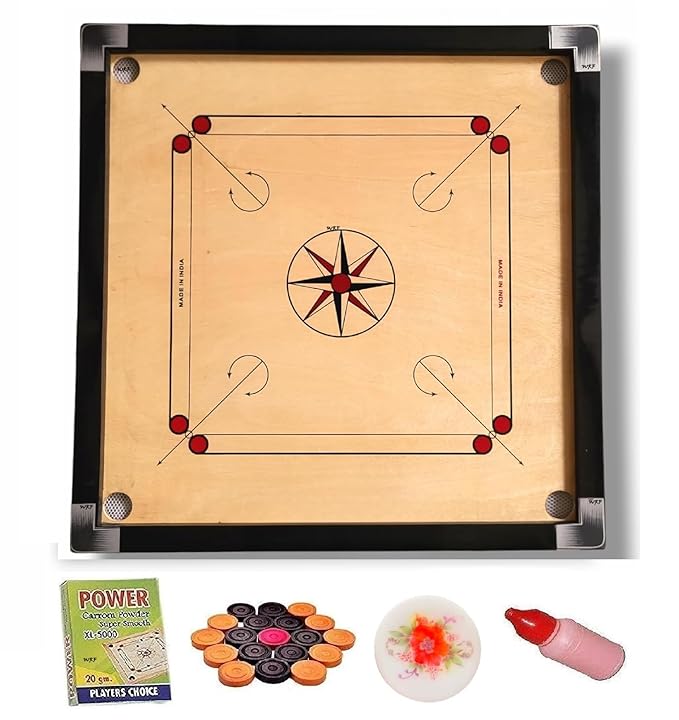
WRF carrom boards are famous for their smooth playing surface and excellent re-bounce capabilities
Carrom Board:
A Complete 2500-Word Guide with Subheadings
1. Introduction to Carrom
Carrom is a widely loved tabletop game played across South Asia and other parts of the world. Combining elements of pool, shuffleboard, and air hockey, it requires precision, skill, and strategic thinking. The central equipment of the game is the Carrom Board—a flat, square wooden surface with four corner pockets, designed for players to flick wooden disks (called carrom men) into these pockets using a striker.
Over the years, carrom has evolved from a casual indoor pastime into a professional sport with international championships and dedicated players. But whether it’s being played in a village courtyard, a family living room, or on a competitive stage, the heart of the game remains the Carrom Board.
2. History of Carrom and Its Origins
2.1 Origins in India
Though the exact origin of carrom is debated, most historians agree that it originated in India during the 18th or early 19th century. Carrom was initially played in royal courts and among the elite, with boards crafted from high-quality wood and adorned with artistic details.
2.2 Colonial Influence
The British colonial period played a significant role in spreading carrom across the Indian subcontinent. Soldiers and officers took a liking to the game, and its rules became more standardized. As British colonies connected, carrom spread to Sri Lanka, Nepal, Pakistan, and Bangladesh.
2.3 Global Spread
Later, through migration and trade, carrom traveled to the Middle East, Africa, Europe, and eventually North America, where South Asian communities introduced the game. Today, international carrom tournaments are held with players from over 30 countries.
3. Structure and Design of a Carrom Board
3.1 Dimensions and Layout
A standard carrom board is a square, usually 74 cm (29 inches) on each side for professional use, with a smooth, polished plywood surface. The board is bounded by wooden frames (or bumpers) and features four circular corner pockets, each approximately 5 cm in diameter.
3.2 Surface Material
-
Plywood is the most commonly used surface.
-
The surface must be smooth and polished for frictionless movement.
-
Fine powder, often boric acid or specialized carrom powder, is used to maintain glide.
3.3 Frame and Base
The border frame is made of hardwood like kikar, neem, or sheesham, providing durability and bounce. Underneath the board, support structures or legs are added for elevation and balance.
3.4 Markings on the Board
-
Center Circle – Where the carrom men are placed before the game begins.
-
Base Circles – For player hand placement during shooting.
-
Arrows and Lines – Aid in aiming and ensure fair play.
4. Components of a Carrom Set
A complete carrom set consists of the following:
4.1 Carrom Board
-
Flat, square wooden board with pockets in all four corners.
-
Standard sizes vary for beginner, club, and championship levels.
4.2 Carrom Men (Coins)
-
9 black, 9 white, and 1 red piece (the queen).
-
Made from wood, plastic, or acrylic.
-
Weight and size are standardized for professional play.
4.3 The Striker
-
Heavier than the carrom men, used to flick the coins into pockets.
-
Materials: Acrylic, plastic, or wood.
-
Diameter: Around 4.1 cm; weight: 15–15.5 grams (as per ICF standards).
4.4 Carrom Powder
-
Finely milled boric acid or silica.
-
Applied to reduce friction and improve glide.
5. Types of Carrom Boards
Carrom boards come in various types to suit different skill levels and purposes.
5.1 Professional Tournament Boards
-
Large, high-quality plywood surface.
-
Strong hardwood borders for maximum rebound.
-
Used in national and international competitions.
5.2 Club-Level Boards
-
Slightly smaller and more affordable.
-
Ideal for regular play in local clubs and community centers.
5.3 Recreational or Home Boards
-
Smaller boards, typically 26 to 30 inches.
-
Lightweight and portable.
-
Designed for family and casual gameplay.
5.4 Kids’ Carrom Boards
-
Miniature boards with colorful designs.
-
Sometimes multifunctional with other games on the reverse side.
6. Sizes of Carrom Boards
There are commonly three standard sizes:
| Board Type | Playing Surface | Frame Size |
|---|---|---|
| Tournament | 29 x 29 inches | 3–4 inches |
| Club/Intermediate | 26 x 26 inches | 2.5–3 inches |
| Home/Compact | 24 x 24 inches | 2 inches |
7. Materials Used in Carrom Boards
7.1 Playing Surface
-
Plywood (Birch, Assam teak, or English birch) is ideal.
-
High-quality plywood is sanded and polished to reduce friction.
7.2 Frame and Border
-
Typically made from durable woods such as:
-
Rosewood
-
Sheesham
-
Neem
-
-
Good frames offer strong rebound and longer lifespan.
7.3 Carrom Coins
-
Wooden coins: Traditional and eco-friendly.
-
Plastic or Acrylic coins: More durable and commonly used in competitions.
7.4 Strikers
-
Often made from acrylic or resin with printed artwork.
-
Competitive players prefer heavier strikers for better control.
8. Rules and Gameplay Overview
8.1 Objective of the Game
The goal is to pocket all your assigned carrom men (black or white) before your opponent, and secure the red queen with a cover shot.
8.2 Game Setup
-
Arrange all 19 coins in the center circle.
-
Queen at the center, surrounded by alternating colors.
-
Each player takes turns to shoot using the striker.
8.3 Basic Rules
-
Players must shoot from their designated side.
-
The striker must touch both baselines before shooting.
-
The queen must be “covered” by pocketing another coin after it.
8.4 Fouls
-
Pocketing the striker.
-
Failing to cover the queen.
-
Breaking the baseline rules.
8.5 Scoring
-
Queen = 3 points (if covered).
-
Each coin = 1 point.
-
Game ends when a player reaches a set score (e.g., 25 or 29) or after a fixed number of boards.
9. Skills and Strategies in Carrom
9.1 Striking Techniques
-
Straight shot
-
Cut shot
-
Rebound shot
-
Thumb shot (using thumb for more power)
9.2 Defensive Play
Players may choose to block opponents’ coins or leave their own coins in challenging positions to prevent easy pocketing.
9.3 Positional Awareness
Understanding angles and rebounds is key to mastering the game. Skilled players often use geometry to anticipate coin trajectories.
10. Health and Cognitive Benefits of Playing Carrom
10.1 Improves Hand-Eye Coordination
The flicking action and precise aiming develop fine motor skills.
10.2 Enhances Concentration
Carrom requires players to plan, focus, and execute carefully.
10.3 Social Interaction
Promotes bonding among family and friends, making it a great indoor team game.
10.4 Stress Relief
Casual carrom sessions provide relaxation and a break from daily routine.
11. Carrom in International Sports
11.1 International Carrom Federation (ICF)
-
Established in 1988.
-
Regulates international rules and tournaments.
11.2 Major Tournaments Carrom Board
-
World Carrom Championship
-
Asian Carrom Championship
-
ICF Cup
11.3 Carrom in Schools and Colleges Carrom Board
Many educational institutions promote carrom as part of their indoor games curriculum.
12. Maintenance and Care of Carrom Boards
12.1 Regular Cleaning Carrom Board
-
Use a soft cloth to wipe the surface.
-
Avoid using water or wet cloths on the plywood.
12.2 Polishing and Powdering Carrom Board
-
Periodically apply carrom powder.
-
Polish the surface with approved wood polish to maintain smoothness.
12.3 Proper Storage Carrom Board
-
Store the board upright or flat in a dry place.
-
Keep away from direct sunlight and moisture.
12.4 Coin and Striker Care Carrom Board
-
Clean coins regularly.
-
Avoid rough handling of the striker to prevent chipping.
13. Innovations and Modern Variations
13.1 Magnetic Carrom Boards
Some boards come with magnetic coins for a new gameplay experience.
13.2 Foldable Boards
Travel-friendly and compact, foldable boards are perfect for small spaces.
13.3 Electronic Scoring Boards
These incorporate digital counters to
Reviews
There are no reviews yet.