
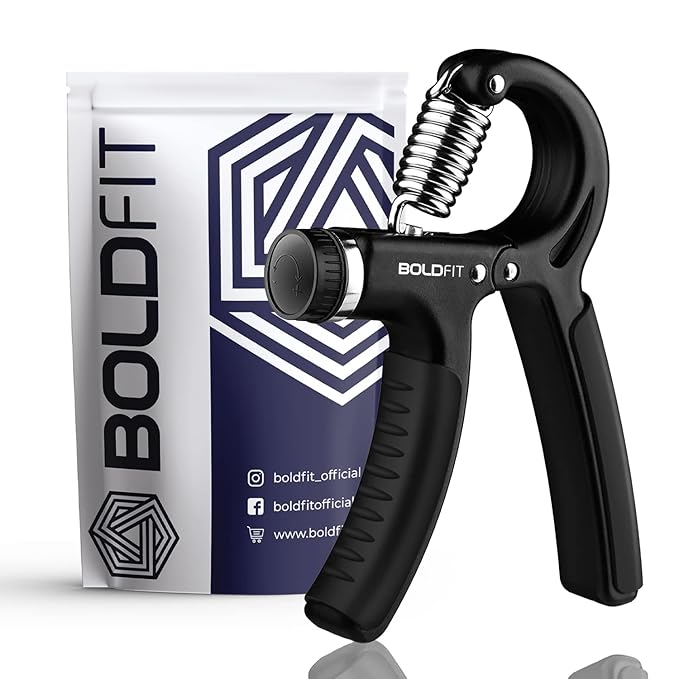
ADJUSTABLE RESISTANCE : Hand gripper 60 kg is easy to adjust the resistance from 10-60Kgs as needs. The hand Gripper is suitable for everyone, like Athletes, sports, fitness coaches, fitness, musicians and people who want to exercise their hand, wrist and fingers. Also its easy and fast to do so. The resistance of hand grips for strength training is perfect for both men and women with different strength as it can be adjusted easily.
Boldfit Adjustable Hand Grip Strengthener, Hand Gripper for Men & Women for Gym Workout Hand Exercise Equipment to Use in Home for Forearm Exercise, Finger Exercise Power Gripper
Original price was: ₹499.00.₹199.00Current price is: ₹199.00.
Description
What is a Hand Grip Strengthener
A Hand Grip Strengthener (also called a hand gripper, grip trainer, hand exerciser) is a device used to build strength, endurance, and control in the muscles, tendons, and ligaments of the hands, fingers, wrist, and forearms. It generally consists of handles and a resistance element, such as a Hand Grip Strengthener coiled spring or adjustable mechanism, which the user squeezes using the hand.
These tools are popular with:
-
Athletes (climbers, weightlifters, martial artists, Hand Grip Strengthener racket sports) who need strong grip.
-
People undergoing v rehabilitation Hand Grip Strengthener (injuries of hand, Hand Grip Strengthener wrist, or forearm).
-
Individuals who want better hand endurance, daily Hand Grip Strengthener functioning (opening jars, carrying things), or who want to reduce risk of overuse injuries.
-
Hobbyists, musicians, gamers, etc. who use Hand Grip Strengthener hands/fingers intensively.
Anatomy / Components / Materials
To understand how grip strengtheners work and what to Hand Grip Strengthener look for, it helps to know their parts and materials.
| Component | Typical Material or Design | Role |
|---|---|---|
| Handles / Grips | Rubber, foam, plastic, or metal with textured/knurled surfaces, sometimes ergonomic shapes | The handles are where you hold; the grip material prevents slipping, improves comfort, protects skin; ergonomic shape reduces strain. |
| Resistance Mechanism | Commonly steel springs (coil or torsion), sometimes adjustable tension via a screw / dial, sometimes rubber bands or elastic, or multiple springs | Provides resistance when squeezing; determines how hard it is. Adjustable ones allow progression. |
| Frame / Body | Steel, zinc alloy, ABS plastic, sometimes aluminum | Holds everything together; should be robust to endure repeated stress. |
| Adjustment Mechanisms (if present) | Dial, screw, clip, lever, variable springs | Allow changing resistance level so user can progressively overload strength. |
| Non‑slip / Cushioning Layers | Rubber or foam padding, textured surfaces, sometimes soft or cushioned handles | To reduce discomfort, prevent slipping due to sweat, bony handle edges, etc. |
Types of Hand Grip Strengtheners
There are multiple designs/types. Choosing the right kind depends on goals (strength vs endurance vs rehab), hand size, convenience, etc.
-
Fixed Resistance Spring Grippers
These have a fixed resistance (rated in Kg or lbs). Simple, durable, no moving parts to adjust. Good for measuring strength (e.g. how many reps or how heavy a fixed resistance you can close). -
Adjustable Resistance Grippers
These allow modifying the resistance via a dial, screw tension, or changing spring tension. Great for progressive training, starting easy and increasing challenge. Many products in India have ranges like 5‑60 kg resistance. Cockatoo+3DeoDap+31mg+3 -
Finger / Digital Grippers / Finger Exercisers
These focus on individual fingers or on the opening action rather than just the squeezing (closing). Good for rehab, fine motor skills, musicians, etc. -
Therapy / Soft Grips
Lower resistance, softer materials. Designed for recovering from injury or for older users. -
Combination or Multi‑Use Tools
Tools that combine hand grip strengthener with wrist / forearm workouts; or grip strengtheners integrated with counters or tracking features.
How It Works: Mechanism & Muscle Engagement
When you use a grip strengthener:
-
You squeeze the handles, which compresses or deforms the resistance element (spring, rubber, etc.).
-
This contraction engages the flexor muscles of the fingers and hand (flexor digitorum superficialis, profundus, etc.), plus muscles of the thumb (thenar muscles).
-
The wrist stabilizers also engage to prevent the wrist from bending or collapsing.
-
The forearm muscles, both flexors and extensors, are involved (especially if you do repeated grips, or maintain grip for holds).
-
Over time, through repeated tension and rest, muscles, tendons, and connective tissues adapt — becoming stronger, more endurance, more resistant to fatigue.
Benefits of Using a Hand Grip Strengthener
Here are what you gain by using one regularly:
-
Improved Grip Strength
Helps you hold heavier weights, rock climb, hang from bars, perform pull-ups, etc. -
Better Forearm Development & Endurance
Repeated use builds endurance in forearms; also works small muscles not always targeted by large compound lifts. -
** Wrist / Hand Stability & Health**
Strengthening tendons and supporting muscles helps reduce risk of injuries like wrist sprains, tendonitis, etc. -
Functional Benefits for Daily Life
Helps in carrying grocery bags, holding tools, opening jars, shaking hands, typing, etc. -
Rehabilitation
After injury or surgery, gradual use of grip strengtheners is often part of physical therapy. -
Stress Relief / Therapy
Many users find squeezing a hand grip can be a way to reduce stress or anxiety. -
Better Performance in Other Sports / Activities
Climbing, martial arts, racket sports, gardening, music – all benefit from stronger grip and better finger control.
How to Choose a Good Hand Grip Strengthener
Choosing the right one ensures effectiveness and comfort.
Key Features to Look For
-
Resistance Range / Level: Fixed or adjustable? What’s the resistance in kg/lbs? If adjustable, what is the minimum and maximum? Ideally starts low enough to be manageable, ends high enough to challenge you. Cockatoo+4DeoDap+4Bulmarc India+4
-
Handle Comfort & Grip: Material (rubber, foam, textured metal/plastic) and shape. Non‑slip handles are important. If handles are too thin or too hard, could strain or hurt palms/fingers.
-
Durability: The spring or resistance mechanism must be well made (steel, coiled, or well‑designed adjustable parts). Cheap springs may lose tension, deform, or break.
-
Size & Portability: If you want to carry it in your bag or use at office/travel, compact size helps.
-
Safety: No sharp edges, no parts that pinch skin, handles that don’t slip off. If adjustable, the mechanism should lock firmly.
-
Grip Type: Do you want a finger exerciser, full hand, or both? Does it allow training both closing grip and opening grip?
-
Price vs Value: Sometimes paying a little more for better quality saves money later (springs breaking, needing new device, etc.).
Typical Resistance Levels & What They Mean
To put resistance numbers into perspective:
-
Entry‑level devices might start at 5‑10 kg resistance. Good for warm‑ups, rehab, beginners. FADMAN+1
-
Mid‑range devices: 20‑40 kg, suitable for regular training, meaningful strength gains. 1mg+2Bulmarc India+2
-
High resistance: 60 kg+, for advanced users, serious grip foce, etc. Some adjustable ones go up to ~60 kg. Cockatoo+3dripfit.in+3DeoDap+3
How to Use It: Technique, Routine, Progression
Proper technique ensures safety and better results.
Technique Tips
-
Use full grip: wrap fingers, ensure thumb is positioned properly.
-
Keep wrist neutral (not bent) to avoid strain.
-
Squeeze fully; hold briefly at maximum contraction, then slowly release. Don’t rely on momentum. Control both squeeze and release phases.
-
Use both hands (left and right) to prevent imbalance.
Sample Workout Routine
| Level | Sets × Reps / Holds | Rest | Notes |
|---|---|---|---|
| Beginner | 2‑3 sets × 8‑12 squeezes (with fixed or moderate resistance) | 1‑2 min rest between sets | Focus on form, don’t rush |
| Intermediate | 3‑4 sets × 12‑20 reps or include hold‑squeezes (hold squeeze 2‑3 sec) | 1 min rest | Increase resistance gradually |
| Advanced | 4‑5 sets × high resistance or heavy adjustable gripper; maybe overload holds; intermittent add open‑hand work or finger grips | 1 min rest or less for endurance focus | Also include grip work during compound lifts or other training days |
Progression & Variation
-
Increase resistance/resistance setting as grip gets stronger.
-
Vary tempo: slow squeeze / slow release; hold at contracted position.
-
Mix grip exercises: crushing grip (closing), pinch grip (between thumb and fingers), support grip (holding), opening grip (counter grip tools).
-
Use fatigue sets occasionally (go near your failure point) to push endurance.
Safety, Limitations & Common Mistakes
Safety / Precautions
-
Warm‑up: Warm hands, fingers, wrists; maybe gentle stretches or warm water if cold.
-
Don’t overdo it: Tendons and ligaments adapt slower than muscle; if you feel sharp pain, swelling, stop.
-
Using both hands to avoid imbalances.
-
Ensure device is working well — springs or adjustable screws well maintained, grips not slipping.
-
For people with hand/wrist injuries, consult a medical professional or physiotherapist.
Common Mistakes
-
Using too high resistance too early, leading to strain or injury.
-
Relying on only squeezing grip – ignoring opening grip or finger extensors, which leads to imbalance.
-
Fast, sloppy reps – using momentum rather than full control.
-
Letting wraps or handles slip or using grip that cause skin chafing or blisters.
-
Training every day without rest — insufficient recovery leads to overuse.
What to Expect: Results & Timeframe
-
Early improvements: Within 1‑2 weeks, you might feel grip endurance improving, ability to do more squeezes with same resistance.
-
Strength gains: Over several weeks (4‑8) if used consistently, increased ability to close higher resistance, less fatigue in hands/forearms.
-
Other benefits: Improved performance in lifts/grips, daily tasks easier, decreased hand fatigue.
-
Maintenance: If you stop, grip strength declines faster than major muscles; consistency even with low volume helps maintain.
Use Cases & Practical Applications
-
Sports: Rock climbing, pull‑ups, deadlifts, martial arts, racket sports, etc.
-
Rehab & Physiotherapy: After wrist/hand injuries, surgery, for arthritis, tendonitis.
-
Daily Life: Better ability to carry heavy bags, open lids/jars, grip in wet or slippery conditions.
-
Hobbies / Occupations: Musicians (guitar, piano), craftsmen, gamers / typing, etc.
Examples from India / Market
To give you an idea of what is offered in the Indian market (features/prices etc.):
-
There are adjustable resistance grippers that go from 5‑60 kg resistance. DeoDap+1
-
Handles are often non‑slip, ergonomic, with rubber or foam. 1mg+2FADMAN+2
-
Products at lower price points have fixed resistance or simple spring grippers. Higher priced ones offer better build quality or wider resistance range.
-
Some brands also offer warranty / durability assurances.
Summary: What Makes an Excellent Hand Grip Strengthener
Putting it all together, the features of a high‑quality hand grip strengthener include:
-
Good build quality: sturdy spring or mechanism, durable handles.
-
Comfort: non‑slip grips, proper handle shape, no parts that hurt skin.
-
Resistance range suited to your level, with ability to progress.
-
Portability and convenience.
-
Safety features / ability to use without causing strain.
-
Value — how long it lasts vs cost.
Reviews
There are no reviews yet.