
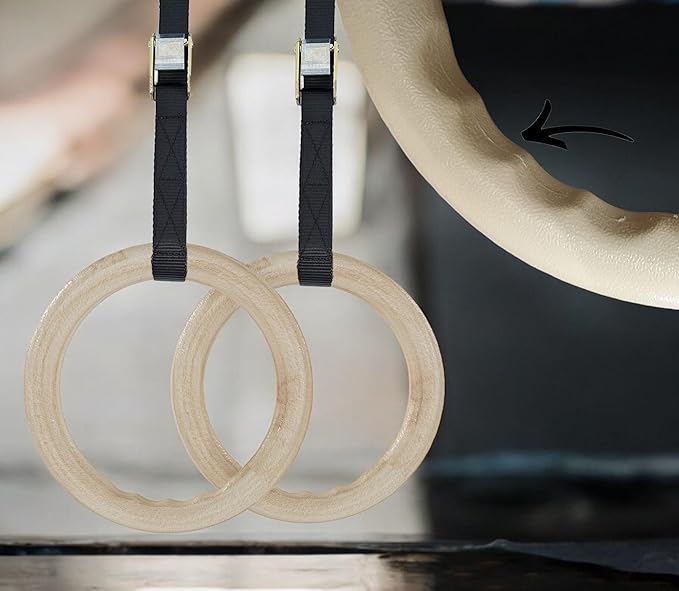
EASY TO INSTALL:- Specifically designed and manufactured so that all users can easily complete installation in less than 5 minutes. You just need to hang around any solid piece of wood or steel, slide in the sling underneath the buckle, and find the appropriate strap length for you, then you are good to go.
TechHark® Gymnastic ABS Rings with Heavy Duty Adjustable Strap Capacity with 14.5ft Adjustable Buckle Straps for Cross Fitness Functional Training for Home Gym Full Body Workout (Gym.Ring Off White)
Original price was: ₹1,798.00.₹999.00Current price is: ₹999.00.
Description
What Are Gymnastic ABS Rings
Gymnastic ABS Rings are a type of workout equipment used in calisthenics, strength training, CrossFit, gymnastics and general fitness. “ABS” refers to the plastic material acrylonitrile butadiene styrene, which is known for good strength, durability, and resistance to impact. These rings are usually suspended by straps and provide a versatile tool for performing a wide variety of body‑weight exercises, especially pushing, pulling, and core work.
Components & Materials
To understand how ABS rings work and why they’re valued, here are the main parts and what they’re built from:
| Component | Typical Material & Build | Significance / Why It Matters |
|---|---|---|
| Ring Body | Usually ABS plastic. Sometimes with additional texture or non‑slip features. | ABS is tough, has good load bearing when properly thick, resists weather, and is less likely to splinter (compared to wood) or rust (compared to metal). The texture helps grip, especially when hands get sweaty. |
| Rim Thickness / Diameter | Common sizes: outer diameters ~ 23‑24 cm, inner diameter ~ 17‑18 cm, rim thickness around 28‑30 mm in many models. Amazon India+3tolymp.de+3JioMart+3 | The dimensions affect comfort, grip, how it feels in hand, how challenging it is. Thicker rims are sturdier but harder to grip; thin rims may be easier for smaller hands but may flex more. |
| Straps | Strong nylon / polyester / polycarbonate webbing, heavy‑duty, often wide (~1 in or more), sometimes with anti‑slip treatments or grip‑tape enhancements. Buckles are metal or strong plastic, designed to resist slippage under load. Strap length often ~4.5 m (≈15 ft) in many commercial sets. Meesho+3JioMart+3Amazon India+3 | Straps must be strong and adjustable. Width affects comfort on shoulder/back while performing certain movements. Long straps allow many setting options (trees, beams, ceilings, rigs) and accommodate different heights. Buckles must be secure, so there is no slippage during use. |
| Attachment Hardware | Buckles, carabiners, possibly speed‑release systems or quick‑lock buckles; sometimes labeling or numbering on straps for easy height adjustment. | Secure attachments are essential for safety. Numbered/marked straps help set both rings to the same height quickly and consistently. |
| Finish & Surface Texture | Smooth or lightly textured ABS; sometimes with non‑slip grip coatings, tapes. | Grip is very important. If it’s too slick (especially when sweaty), usability drops and risk of slipping increases. If too rough, it may irritate the hands. |
How They Work / Mechanics of Training
The principle behind gymnastic rings is instability + freedom of movement + load control. Because the rings are free to move in multiple planes, your muscles must engage stabilizers (shoulder, scapular, core) more than in rigid equipment. The suspended nature means many exercises become more challenging, even if they’re similar in name to bar or machine versions.
Key mechanical features:
-
Lever arms and torque: For example, in ring dips or ring push‑ups you get additional torque and need more shoulder and core control.
-
Range of motion: Rings allow deeper or more natural motion (e.g. wider dips), and also allow rotating your wrists to more comfortable angles.
-
Core engagement: Because rings can swing, even static holds (like L‑sit, plank on rings) force you to stabilize with your core, back, glutes.
-
Variable difficulty via angle & height: By changing body angle (lean), ring height, strap length you can make exercises easier or harder.
Common Exercises
Gymnastic ABS Rings enable many body‑weight movements. Some common ones:
-
Pull‑ups / Chin‑ups (neutral grip, rotating grip)
-
Rows (body horizontal, inverted rows)
-
Dips
-
Push‑ups (feet elevated, rings low)
-
Muscle‑ups (pull + transition + push)
-
L‑sit / Tuck‑L‑sit holds
-
Push / pull levers
-
Skin‑the‑Cat / German Hang for mobility and shoulder flexibility
-
Front or back flies
-
Static holds (support hold, planche variations, etc.)
Because of the instability, many of these are harder on rings than on static bars or parallel bars.
Benefits of Gymnastic ABS Rings
Gymnastic rings offer several advantages over Gymnastic ABS Rings more static strength training tools:
-
Enhanced Core Stability & Full‑Body Engagement
The unstable platform means not only arms/back but core, shoulders, and stabilizers must work continuously to maintain position. -
Joint‑Friendly Movement
Rings often allow more natural joint motion Gymnastic ABS Rings (wrists, shoulders) because they are not fixed. This can reduce strain compared to fixed Gymnastic ABS Rings handles. -
Versatility & Portability
The equipment is compact, light, easy v to hang on many structures (trees, beams, pull‑up bars, rigs). Good for home, outdoors, travel. Many ABS ring sets come with long, adjustable straps. JioMart+2Meesho+2 -
Scalable Difficulty
Beginners can start with easier angles, short lever arms, lower height. Advanced users can progress to harder variants (muscle‑ups, holds, deep rings dips, etc.). -
Muscular Hypertrophy and Strength Gains
Because of the greater activation of stabilizer muscles, increased range of motion, and difficulty in controlling movement, rings can help in building muscle strength and size, not just endurance. Also helps in posture and mobility. -
Improved Grip Strength & Wrist / Forearm Function
Rings shift more burden onto grip and require Gymnastic ABS Rings more wrist stability (since the rings are free to move). Over time improves grip, forearms. -
Natural Motion & Mobility
Movements like skin‑the‑cat, ring levers, reverse hang allow shoulder mobility, scapular motion, which may improve flexibility and reduce risk of injury.
Limitations & Drawbacks / What to Be Careful About
While ABS rings are great tools, they come with Gymnastic ABS Rings caveats and potential issues, particularly if technique is poor or gear is low quality.
-
Strength & Control Demands: Many ring exercises can be too difficult for beginners, leading to injury if not progressed properly. It’s easy to overload the shoulders, elbows, or wrists if stability/control is lacking.
-
Strap / Buckle Quality: Low‑quality Gymnastic ABS Rings straps or buckles might slip under load, fray, or fail. ABS itself can also crack if rim is too thin or quality is poor.
-
Grip Fatigue & Skin Abrasion: Because you’re gripping round, mobile rings, your hands may get more fatigued. Also risk of blisters or abrasions if grip is rough. Using chalk or grip tape helps.
-
Setup & Stability Issues: Rings must be hung from strong, secure anchors. Height must be adjustable and equal for both rings; mismatched rings cause uneven load, strain.
-
Space & Clearance: Need overhead support, enough vertical/horizontal space to swing or use full range movements without hitting obstacles.
-
Overuse & Shoulder Stress: If doing Gymnastic ABS Rings frequent deep dips or muscle ups without good shoulder mobility and rest, risk of strain or impingement.
Safety & Proper Technique
To use ABS rings safely and Gymnastic ABS Rings effectively, pay attention to technique and preparation.
Pre‑use Checks
-
Inspect rings, straps, buckles Gymnastic ABS Rings for wear, cracks.
-
Ensure overhead anchor is secure Gymnastic ABS Rings and can handle load.
-
Make sure both straps are the same length; rings are level.
-
Use proper grip (full wrist alignment, not bent excessively).
Warm‑Up & Mobility
-
Warm up shoulders, wrists, scapula, Gymnastic ABS Rings chest. Movements like arm circles, band pull‑aparts, scapular retraction/depression.
-
Do mobility drills for shoulders if deep Gymnastic ABS Rings dips or overhead positions are planned.
Movement Execution Tips
-
Start with easier versions: inverted rows, Gymnastic ABS Rings push‑ups, partial support holds before full dips or muscle ups.
-
Maintain tension: core tight, glutes and legs engaged, avoid swinging unless specifically training dynamic moves.
-
Use controlled movement, avoid jerks or Gymnastic ABS Rings momentum (especially on descent).
-
Breathing: exhale during effort, inhale Gymnastic ABS Rings during lowering/resting phases.
Progression & Regression
| Goal | Regression (easier) | Progression (harder) |
|---|---|---|
| Dips | Bench or parallel bars or partial range on rings | Deep rings dips, weighted dips, ring fly‑dips |
| Pullups / Rows | Rows with feet planted, assisted pullups | Muscle‑ups, weighted pullups, one‑arm variants |
| Holds (support / L‑sit) | Tuck holds, shorter duration, knee support | Full L‑sit, longer hold, straddle‑L, planche progressions |
Maintenance & Care
-
Avoid exposing ABS to extreme UV for Gymnastic ABS Rings long periods (though many ABS rings are weather‑resistant); store properly.
-
Dry down rings and straps if used Gymnastic ABS Rings outdoors or in damp/humid conditions.
-
Clean grip surfaces to avoid build up Gymnastic ABS Rings of sweat/oil (which can reduce grip).
-
Replace straps or buckles if any sign Gymnastic ABS Rings of damage.
Spec & Performance – Examples from Real Products
Looking at real ABS ring products helps illustrate typical specs, so you know what to expect or compare.
| Product / Model | Key Specs | Load Capacity / Strength | Notable Features |
|---|---|---|---|
| Strauss ABS Gymnastics Ring set | Out‑diameter ~ 23.5 cm; inside ~ 17.5‑18 cm; ring thickness ~ 3 cm; strap length ~ 4.5 m; weight ~ 1‑1.3 kg. Amazon India+3JioMart+3Amazon India+3 | Advertised up to ~ 400‑kg with heavy duty straps or 990 lbs (~ 450 kg) in some product lines. Amazon India+2Meesho+2 | Adjustable straps, anti‑slip surfaces, wide strap buckles, portable and usable in many locations. |
| TechHark ABS Rings | ~ 14.5 ft strap length, strong buckles, good strap width, ABS rings with load capacity advertised up to ~ 1100 lbs / 600 kg for some versions. Meesho+1 | Very high load capacity; heavy duty webbing; marking or numbering of straps. | Designed for functional training / home gym, many color or strap style options. |
| TOLYMP ABS Plastic Rings | Outer diameter ~235 mm, inner ~179 mm, rim thickness ~28 mm; strap ~450 cm; load up to ~ 300 kg. tolymp.de | 300 kg is solid for most body‑weight plus dynamic load users. | Weatherproof ABS, wide straps, good build quality. |
These help set benchmarks: what sizes/strengths are normal, what features are premium.
Variations & Alternative Materials
While ABS rings are popular, there are alternatives or variations to consider, each with trade‑offs:
-
Wooden rings — often smoother feel, good grip; some prefer the natural texture; but potential for splinter, less weather resistance.
-
Metal rings — steel/aluminum; very strong, durable; may be heavy, cold to handle, risk of rust or discomfort in cold/hot conditions.
-
Composite or mixed materials — combinations of ABS plastic with coatings, rubberized texture, or hybrid rings (ABS + wood inside, etc.).
-
Width / Rim size variations** — thinner rings for smaller hands, thicker ones for advanced grip strength.
-
Strap & buckle systems — quick‑adjust, cam buckles, number‑marked straps, ratchet systems etc.
Who Benefits & Who Needs Caution
Ideal Users
-
People training for calisthenics, body‑weight strength, CrossFit, gymnastics.
-
Those wanting to strengthen core stabilizers, improve shoulder stability and mobility.
-
Anyone who wants portable equipment, or training outdoors or in constrained spaces.
-
Lifters who want more functional stability, or want to reduce joint stress compared to rigid bars.
Those Who Should Be Cautious
-
Beginners with very weak core, shoulders or no prior body‑weight training; one should build up with simpler tools first (like bar pull‑ups, push‑ups, etc.).
-
People with shoulder, wrist, elbow injuries; must ensure mobility and technique before doing deep dips or complex movement.
-
Those using low quality gear (cheap ABS, flimsy straps) should be particularly careful.
-
Elderly or persons lacking grip strength may find them hard to use initially; risk of slipping or over‑straining.
Typical Use Cases & Training Applications
Gymnastic ABS rings can be incorporated in many training settings:
-
Home gyms — inexpensive, takes little space; rings + straps + a beam or bar = many exercise options.
-
CrossFit / Functional Fitness — rings are staple (dips, muscle ups, etc.).
-
Outdoor training / Parks — hang from tree branches, playground equipment, etc.
-
Rehab / Mobility — lighter or assisted ring work for shoulder / scapula health, flexibility, core engagement.
-
Travel / Minimalist setups — one small package yields versatile workout options.
Marketing / Buying Factors (What Users Should Look For)
If you are buying / marketing ABS rings, the following are key decision points:
-
Load Capacity — how much weight it can take safely; important if you add extra weight (vests, chains) or do dynamic moves.
-
Rim Thickness & Diameter — comfort, hand size, grip difficulty.
-
Strap Length & Adjustability — longer straps allow more options; adjustable straps improve flexibility of use.
-
Strap Material & Buckle Hardware — better materials last longer, support more load, less slippage.
-
Grip Texture / Surface Finish — anti‑slip, smooth or textured; coatings or tapes.
-
Weather Resistance / Portability — rings that can handle outdoor exposure; ease of packing and setup.
-
Accessories / Extras — carrying bag, grip tape, numbered straps, protective pads, etc might add value.
Sample Routine / How To Incorporate Them in Training
Here’s a sample progression‑oriented plan showing how someone might include ABS rings in their fitness routine:
| Week | Focus | Exercises | Reps / Sets / Notes |
|---|---|---|---|
| Weeks 1‑2 (Beginner) | Stability, basic form | Support hold on rings, body row (feet on ground or elevated slightly), push‑ups with rings low, assisted dips (partial) | 2‑3 sets × 5‑8 reps or 10‑30 sec holds; focus on control |
| Weeks 3‑4 (Intermediate) | Strength & motion | Full ring push‑ups, full ring rows, dips, negatives, maybe tuck‑L‑sit holds | 3‑4 sets × 8‑12 reps or 20‑40 sec holds |
| Weeks 5‑8 (Advanced) | Dynamic & high difficulty | Muscle‑ups, ring flyes, deep dips, L‑sit to support, static levers, longer/unsteady holds, maybe weighted versions | 3‑5 sets; mixture of reps and hold times; ensure rest days for recovery |
Pair with supportive training (mobility, rotator cuff, scapular stability) and rest.
Real‑World Examples & Specifications (from Indian/Global Market)
To give concrete numbers and what users are getting, here are real product‑specs:
-
Strauss ABS Gymnastics Rings: diameter 23.5 cm, inner diameter ~17.5 cm, ring thickness ~3 cm; strap length ~4.5 m; advertised to handle ~ 400 kg in many versions. StraussSport+2Amazon India+2
-
JoyFit ABS Gymnastic Rings: support up to ~ 990 lbs (~ 450 kg); extra anti‑slip blue tape; wide polyester straps; roughly similar strap length (~14.7 ft ~ 4.5 m). Amazon India
-
TOLYMP ABS Plastic Rings: outer diameter ~ 235 mm, inner diameter ~ 179 mm, rim thickness ~ 28 mm; strap length ~ 4.5 m; load up to ~ 300 kg. tolymp.de
These figures show what’s possible and what users often see.
Summary
-
Gymnastic ABS Rings are a flexible, powerful tool for body‑weight strength, stability, mobility, and core development.
-
Made of ABS plastic with strong straps and hardware, they allow for many variations of push, pull, holds, mobility work.
-
Great for both beginners (with regressions) and advanced athletes (with progressions).
-
Key is quality — of ring material, strap, buckle, grip surface — and safe, proper technique.
Reviews
There are no reviews yet.