
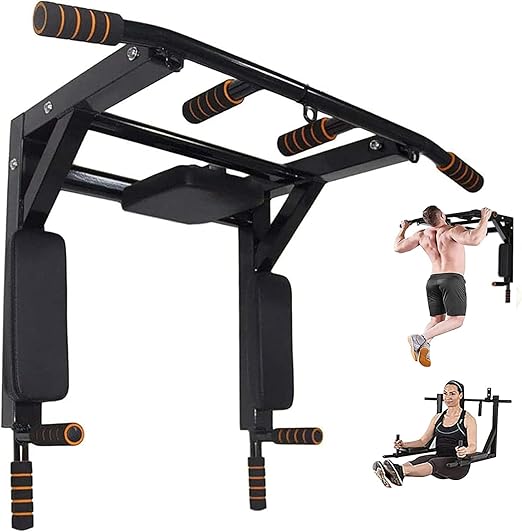
【Heavy Duty Material Construction】:This SX Fitness wall mounted pull up bar is made of heavy duty material,which offers great stability and rigidity,supports up 200 kg.
SX Fitness Heavy Duty Multifunctional Wall mount pull up bar, wall mount 3 in 1, Chin up bar, home gym equipments, dip Station for Training at Home for Men, Women
Original price was: ₹5,999.00.₹2,397.00Current price is: ₹2,397.00.
Description
Pull‑Up Bar:
An In‑Depth Description
Introduction
pull up bar is a piece of fitness equipment designed primarily for upper‑body strength training, facilitating exercises like pull‑ups, chin‑ups, hanging leg raises, and other variations. It is a vital tool in many fitness routines, calisthenics, bodyweight training, and often part of home gym or commercial gym setups. The pull‑up bar allows a person to lift their own body weight by pulling up on a bar fixed overhead.
Throughout this description, pull up bar we’ll cover types, construction, biomechanics, benefits, usage, design considerations, safety, maintenance, common mistakes, and variations/training progressions.
Types of Pull‑Up Bars
Different pull‑up bars are designed pull up bar to meet varied needs of space, portability, user strength, and training variety. Common types include:
-
Doorway / Jam‑Style Bars
-
These are bars that mount pull up bar across a door frame, using leverage or tension to stay in place.
-
Usually removable and portable, no permanent installation needed.
-
-
Wall‑Mounted Bars
-
Fixed to a wall using bolts/anchors.
-
More stable and can handle higher loads; offer wider grip options.
-
Requires permanent space, strength of wall structure important.
-
-
Ceiling‑Mounted Bars / Overhead Beams
-
Bars mounted to ceiling joists or beams. Often used in garages, basements, or gyms.
-
Very sturdy, can often be long to allow multiple grip positions or multiple users.
-
-
Freestanding / Power Towers
-
Rigs or towers that have integrated pull‑up bars, often pull up bar with dip stations, push‑up handles, etc.
-
Don’t need mounting but occupy more floor space.
-
-
Outdoor / Park Pull‑Up Bars
-
Part of outdoor fitness parks. Usually heavy‑duty steel, corrosion‑resistant.
-
Very high durability, weather resistant, permanently installed.
-
-
Adjustable / Multi‑Grip Bars
-
Bars that allow grip to be changed (neutral grip, angled, rotating) or have multiple handle positions.
-
Some have pivoting or rotating grips for pull up bar comfort or joint protection.
-
-
Portable / Suspended Bars
-
Bars that can be hung from sturdy supports (trees, beams, crossbars). Some use slings or straps.
-
Useful for travel, no need for fixed pull up bar installation, but require a strong anchor point.
-
Materials & Construction
The materials and methods used in pull‑up bars are important for durability, safety, and comfort:
-
Metal Type:
Steel is most common, either plain steel, stainless steel, powder‑coated steel or chromed. Stainless or well‑coated steel resists rust and wear. Mild steel with protective coatings are also frequent for cost reasons. -
** Diameter / Grip Thickness:**
Bar diameter influences grip comfort and pull up bar difficulty. Standard diameters are about 25‑35 mm (1‑1.4 in). Thicker bars increase challenge; thinner are easier for smaller hands. -
Finish / Texture:
Smooth finishes are easier on the grip but may slip if hands are sweaty. Knurled or textured surfaces improve grip friction. Rubber or foam sleeves are sometimes used for comfort or to protect hands. -
Weight Capacity / Load Rating:
Depending on installation type, pull‑up bars vary in how much weight they can safely support. High‑end wall/ceiling‑mounted bars or outdoor bars can often handle several hundred kilograms, while doorway or portable versions may be rated to 100‑150 kg or less. -
Mounting Hardware:
Includes bolts, screws, brackets, anchor plates. Quality and size of hardware matter greatly for structural integrity. The hardware must be suitable for the wall or ceiling type (wood studs, concrete, brick, drywall etc.). -
Corrosion Resistance:
Especially important for outdoor bars; galvanization, stainless steel, powder coating, epoxy coatings are used. -
Joint construction / Welding:
Weld quality is important for stability and safety. Welds should be clean, without cracks or sharp edges.
Biomechanics and Muscles Worked
Pull‑ups are compound movements, engaging multiple muscle groups, stabilizers, and joints. Understanding biomechanics helps in maximizing benefits and avoiding injury.
-
Primary Muscles:
-
Latissimus Dorsi (“lats”) – the broad back muscles under the arms.
-
Biceps Brachii – front of the upper arm.
-
Rhomboids and Middle / Lower Trapezius – between the shoulder blades.
-
Posterior Deltoids – rear shoulders.
-
-
Secondary / Supporting Muscles:
-
Forearms and Grip Muscles – fingers, hand, wrist flexors.
-
Core Muscles – abdominals, obliques; required to stabilize the torso.
-
Rotator Cuff Muscles – to maintain shoulder joint integrity during the movement.
-
Pectoralis Major (some involvement, depending on grip and technique).
-
-
Joint Actions:
-
Shoulder: extension (pulling arms downward/back), adduction, some retraction.
-
Elbow: flexion.
-
Scapular Movement: retraction, depression.
-
-
Range of Motion:
-
Start from a dead hang (arms fully extended) → pull until chin or chest is above the bar depending on variation → lower back to a controlled dead hang.
-
-
Grip Variations:
-
Overhand / Pronated Grip – standard pull‑ups.
-
Underhand / Supinated Grip – chin‑ups; more biceps involvement.
-
Neutral Grip – palms facing each other; often easier on wrists/shoulders.
-
Wide Grip – more lat emphasis, harder.
-
Narrow Grip – more biceps and forearms.
-
Benefits of Using a Pull‑Up Bar
Pull‑up bars provide many fitness, health, and psychological benefits:
-
Upper Body Strength & Muscle Development
Regular pull‑ups build strong lats, biceps, back, shoulders. Helps posture by strengthening back musculature. -
Functional Fitness
Pull‑ups are compound, multi‑joint, and imitate natural movements: pulling, lifting, climbing. Improves daily functional capacity. -
Core Strength & Stability
Hanging from the bar requires engagement of core to prevent swinging; adds stability and control. -
Grip Strength
Holding and pulling one’s weight strengthens fingers, hands, forearms — useful in many sports/tasks. -
Scapular Health & Shoulder Mobility
Proper pull‑ups involve scapular retraction/depression and can improve shoulder girdle health and mobility. -
Weight Management & Fat Loss
Bodyweight exercises burn energy; high‑repetition pull‑ups or circuits with pull‑ups assist in caloric burn. -
Convenience and Versatility
A pull‑up bar is simple, relatively inexpensive, and can be used almost anywhere (home, gym, outdoors). Has many variations so workouts can be modified. -
Psychological Benefits
Mastering pull‑ups is often seen as a benchmark of strength. Progressing from one pull‑up to many increases motivation, confidence, self‑efficacy.
Design & Ergonomic Considerations
To get the most value from a pull‑up bar, one should consider these design details:
-
Height Clearance
The bar must be high enough that the user in full extension (dead hang) does not touch ground/surface under them. Also space to pull up without head hitting ceiling or obstruction. -
Grip Width & Adjustability
There should be sufficient space laterally for wide, medium, and close grip. Multi‑grip options are useful for variation. -
Comfort of Grip
Diameter should suit hands; avoid too thick a bar unless training for that. Smooth or slightly textured finish; padding or grip sleeves for comfort. -
Stability / Minimal Bounce
The bar should not flex excessively or oscillate under load; stable mounting is essential. -
Clearance Around Bar
Enough room for arms, shoulders to move freely; no obstruction above or behind that could cause injury. -
Easy Access / Installation
If door‑jam style, should be easy to install, remove, store. For fixed bars, installation should be straightforward or with professional assistance. -
Safety Features
Rounded edges, no sharp welds; reliable locking mechanisms; slip‑resistant or grip aid surfaces; hardware rated for more than expected load. -
Material & Finish
For outdoor bars, rust resistance; for indoor, finish that doesn’t wear off or become slippery.
How to Use a Pull‑Up Bar: Technique & Progressions
Good technique and proper progression help maximize benefits while reducing injury risk.
Basic Technique for Standard Pull‑Up
-
Warm Up
Shoulders, arms, wrists; dynamic movements (arm circles, scapular pull‑ups) to mobilize joints. -
Grip the Bar
Hands shoulder‑width apart (or grip variation). Pronated (palms facing away) for standard pull‑ups. -
Dead Hang
Hang with arms fully extended, shoulders relaxed, core engaged. This is starting position. -
Scapular Retraction & Depression
Pull shoulders down and back slightly before bending elbows (this activates the lats and protects shoulder joints). -
Pull
Drive elbows down toward the floor, pulling chest (or chin) toward bar. Avoid swinging or using momentum. -
Top of Movement
At the top, chin over bar (or chest to bar), shoulders lightly compressed; avoid shrugging up to ears. -
Lowering Phase (Eccentric)
Lower in a controlled manner back to dead hang; resist gravity. This phase is important for strength and muscle growth. -
Repeat / Controlled Reps
Maintain technique in each rep; avoid collapsing shoulder, bouncing, swinging.
Progressions & Variations
-
Assisted Pull‑Ups
Use resistance bands, assisted pull‑up machines, or partner to reduce amount of body weight. -
Negative / Eccentric‑Only Reps
Jump or step up to top position, then lower slowly; builds strength if you can’t perform full pull‑up yet. -
Isometric Holds
Hold chin above bar, or halfway position, or dead hang; builds endurance & control. -
Different Grips
Wide grip, close grip, neutral grip, supinated grip etc. -
Weighted Pull‑Ups
Once bodyweight pull‑ups are manageable, add weight via belt, vest or chains. -
One‑Arm / Archer / Typewriter Pull‑Ups
Advanced variations for further strength and unilateral development. -
L‑Sit Pull‑Ups / Hanging Leg Raises
Combine with core work; keep legs straight out or raise knees or legs while pulling.
Safety, Risks, and Common Mistakes
Using a pull‑up bar improperly or with poor setup can lead to injury. Here are potential risks and how to avoid them.
Risks
-
Shoulder strain or injury, especially rotator cuff, if poor form or too much load.
-
Elbow or wrist strain from improper grip or handle width.
-
Falls if bar is not properly installed, hardware fails, or grip slips.
-
Overuse injuries: tendinitis in shoulders, elbows.
-
Skin abrasions / blisters on palms or fingers.
Common Mistakes
-
Using Momentum / Kipping (uncontrolled swinging) prematurely, which reduces effectiveness and increases risk.
-
Partial Reps — not using full range of motion (not extending fully at bottom, not pulling high enough) diminishes benefit.
-
Shrugging Shoulders at Top — lifting shoulders toward ears instead of focusing on back; can strain neck.
-
Letting Core Sag / Swing — loss of control, stress on lower back.
-
Excessively Wide Grip — might decrease strength leverage, put shoulder joints at risk.
-
Rushing Through Reps — lack of control especially in lowering phase reduces muscular gains and safety.
Safety Tips
-
Always inspect the pull‑up bar and its mounting hardware before use.
-
Use proper personal grip tools: gloves, chalk, or grip pads if needed.
-
Warm up well, especially shoulders and wrists.
-
Progress gradually; don’t try advanced variations before mastering basics.
-
Ensure environment is safe: non‑slippery flooring; area under bar free from objects; sufficient clearance.
-
If mounting, use studs or solid masonry; ensure load ratings are sufficient.
Installation & Mounting Considerations
Depending on type, installing a pull‑up bar can be straightforward or quite involved.
Doorway Bars
-
Must fit the frame’s width properly.
-
Should have rubber pads or protective ends to prevent damage to door frame.
-
For leverage‑mounted versions, ensure thresholds and frames are strong enough.
-
Weight limit usually lower than fixed bars.
Wall / Ceiling Mounted
-
Identify studs / beams; use structural supports (wood joists, concrete, steel).
-
Use heavy‑duty bolts, lag screws, or expansion anchors appropriate to the material.
-
Mount bracket plates flush with wall; ensure correct spacing.
-
Test after installation with a heavy load before use.
Outdoor Installations
-
Use weather‑resistant materials (galvanized bolts, stainless steel).
-
Ensure proper drainage (no water pooling that can rust joints).
-
Exposure to elements means periodic maintenance (painting, checks).
Maintenance
To ensure longevity and safety:
-
Periodically check all bolts and mounting hardware for tightness.
-
Inspect welds and joints for cracks or fatigue.
-
If rust appears, treat or repaint/coating as required.
-
Lubricate moving parts (if adjustable/pivoting grips).
-
Clean grip area (sweat and dirt can degrade finish, cause slippage).
-
Replace worn grip covers or sleeves when necessary.
Selecting the Right Pull‑Up Bar for Your Needs
When selecting a pull‑up bar, consider the following factors:
-
Your current strength & goals
If you are a beginner, perhaps a doorway bar with assisted progression; if advanced, a heavy‑duty wall/ceiling or outdoor version for weighted pull‑ups or multiple users. -
Space available
Ceiling height, wall space, door frames etc. For small apartments, removable or low space‑requirements models are better. -
Budget
Prices vary from inexpensive doorway bars to professional rigs costing more. Balance cost vs durability and safety. -
User Size & Grip
Larger users or those planning to add extra weight need stronger, sturdier bars with high load capacities. Also, hand size affects grip diameter. -
Multi‑User Use / Family / Gym Use
If more than one person uses it, higher durability, more grip options, safety become even more important. -
Variability & Progression
If you plan to do many variations (wide, neutral, weighted, etc.), having a bar that supports multiple grips or accessories (like dip handles) is valuable. -
Portability vs Permanence
Do you need something you can take down / move? Or is the bar going to be a permanent fixture?
Case Studies & Examples
To illustrate how different environments or users find pull‑up bars useful:
-
Home Gym – Apartment Dweller
A resident in a small flat might choose a doorway‑jam pull‑up bar or fold‑away wall‑mounted model, so they can remove it when needed. Grip covers protect wooden door frames; rubber pull up bar pads pull up bar to avoid damage. Probably start with assisted pull‑ups, negative reps, moving to full pull‑ups over time. -
Outdoor / Park Use
City parks often have steel pull‑up bars as part pull up bar of calisthenics installations. Heavy‑pull up bar duty steel, welded joints, powder‑coated or galvanized to resist rust. Exposed pull up bar to sun, rain; require materials that can endure weather; accessible to many users; often fixed very high and wide to accommodate different heights, grip widths. -
Commercial Gym Use
Wall or ceiling‑mounted or large rigs with bars at various heights. Very heavy pull up bar pull up bar load ratings; multiple users; frequent safety inspections. Variations included grip attachments, bands, etc. -
Calisthenics Athletes
Use bars with thick diameters, pull up bar multi‑grip possibilities, often combine with rings or other apparatus. They may mount bars outdoors for the feel, and use weighted vests, advanced variations, one‑arm training.
Psychological & Training Aspects
-
Progress Tracking: Pull‑ups are easily measurable: pull up bar number of reps, grip variation, weighted reps, etc. This shows tangible progression.
-
Goal Setting: E.g., first pull‑up, first 5, pull up bar first 10; first wide grip; first weighted pull‑up.
-
Motivation: Many people find pull‑ups difficult initially; achieving them can be very rewarding, boosting self‑confidence.
-
Plateau Breaking: By changing grip, pull up bar adding weight, slowing tempo, or doing negatives / isometrics, one can break through strength plateaus.
Variations and Complementary Exercises
To get full use out of a pull‑up bar, you can pull up bar combine with or pull up bar substitute:
-
Hanging Leg / Knee Raises: Hanging pull up bar from the bar, raise knees or straight legs; excellent for core.
-
Toes to Bar: Advanced core movement; flexibility also comes into play.
-
Muscle‑Ups: Pull up then transition to pushing over the bar; very advanced.
-
Australian Pull‑Ups / Body Rows: Using a pull up bar lower bar; feet on ground; more accessible for beginners.
-
Lat Pull‑Downs (machine) or Pulley‑based substitute if no bar available.
-
Inverted Rows: Similar to body pull up bar rows; good for horizontal pulling.
Sample Training Program Incorporating Pull‑Up Bar
Here is a hypothetical 8‑week progression for someone starting to train pull‑ups:
| Week | Focus | Reps / Sets / Type |
|---|---|---|
| 1‑2 | Build grip & scapular strength; negative reps | 3×5 negatives; dead hang holds 3×20 sec; assisted pull‑ups 3×3 |
| 3‑4 | Increase full reps / improve technique | Try 1 full pull‑up; aim for 3×2; continue negatives; grip variations |
| 5‑6 | Volume increase & variation | 4×3 full pull‑ups; neutral grip; wide grip; add isometric holds |
| 7‑8 | Strength & resistance | Weighted assisted if possible; introduce small weight; increase depth and reps; aim 4‑5×5 full pull‑ups |
Also integrate rest days, shoulder & core conditioning, mobility work.
Conclusion
A pull‑up bar is a deceptively pull up bar simple tool with immense potential. When chosen and used well, it can:
-
Offer major strength, muscle, and functional fitness gains;
-
Be adapted for all levels of ability; pull up bar
-
Occupy minimal space (depending on type);
-
Offer great value for pull up bar money.
However, safety, correct form, gradual progression, and suitability to user needs are essential to avoid injury and to maximize long‑term benefit.
Reviews
There are no reviews yet.