
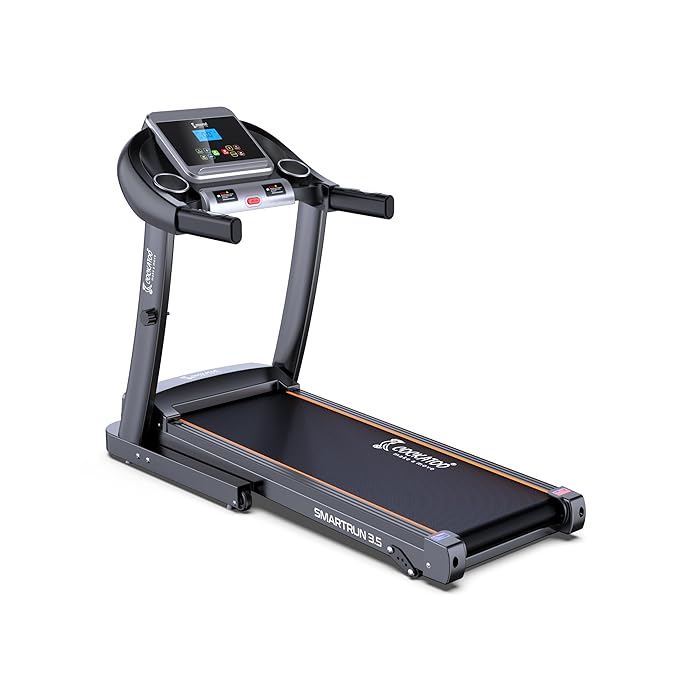
Powerful Motor: Equipped with a 3.5HP Peak (2HP Regular) motor, providing consistent performance for all workout intensities, ideal for both walking and running.
Treadmill for Home:
The Ultimate Buyer’s Guide
The treadmill is one of the most popular and effective pieces of exercise equipment. Whether you’re trying to lose weight, improve cardiovascular health, or maintain overall fitness, a treadmill can be a valuable addition to your home. But with countless models and features on the market, choosing the right treadmill for home use can be overwhelming.
This guide is designed to simplify your decision. From understanding the types of treadmills to the features you should consider and how to use and maintain your treadmill properly, this article provides everything you need to make an informed purchase and get the most out of your investment.
1. Why Choose a Treadmill for Home Use?
There are numerous benefits to owning a treadmill at home. Here are some of the top reasons:
1.1 Convenience
A home treadmill eliminates the need to commute to the gym, allowing you to work out at any time that suits you—morning, afternoon, or night.
1.2 Weather-Proof Workouts
Rain, snow, or extreme heat won’t stop your fitness routine. You can walk, jog, or run in a controlled, indoor environment.
1.3 Privacy
Many people feel more comfortable exercising in the privacy of their home rather than in a public gym.
1.4 Family Fitness
A treadmill can be used by multiple family members, promoting a healthier household.
1.5 Long-Term Savings
Although treadmills can be an upfront investment, they often save you money on gym memberships over time.
2. Types of Home Treadmills
Understanding the different types of treadmills is essential when deciding what best suits your space, goals, and budget.
2.1 Manual Treadmills
These treadmills are powered by your movement. They’re usually smaller and cheaper but may not be ideal for intense cardio.
2.2 Motorized Treadmills
These come with a motor that drives the belt. They are more feature-rich and are the most common type used at home.
2.3 Folding Treadmills
Perfect for small spaces, folding treadmills can be folded and stored away when not in use.
2.4 Under-Desk Treadmills
Slim, quiet, and designed for walking at low speeds, these are great for pairing with a standing desk.
2.5 Curved Treadmills
Non-motorized and often used for high-intensity interval training (HIIT), these are more common in performance training settings.
3. Key Features to Consider
When buying a treadmill, consider these important features to ensure you get a model that suits your fitness goals and space constraints.
3.1 Motor Power
Motor power is measured in horsepower (HP). Look for:
-
2.0–2.5 HP for walking
-
2.5–3.0 HP for jogging
-
3.0+ HP for running
3.2 Running Surface (Belt Size)
Ensure the belt is long and wide enough for your stride. A good size is:
-
Minimum 48″ L x 16″ W for walking
-
Minimum 55″ L x 20″ W for running
3.3 Speed and Incline
Check the top speed (usually 10–12 mph) and incline options (manual or motorized, up to 15%).
3.4 Shock Absorption
Good cushioning reduces joint impact and lowers the risk of injury.
3.5 Display and Controls
Look for easy-to-read displays that show time, speed, distance, calories, and heart rate.
3.6 Pre-Set Programs
Many treadmills include workout programs to help you vary your routine and stay motivated.
3.7 Heart Rate Monitoring
Some treadmills have built-in sensors or support chest strap monitors to track your heart rate.
3.8 Connectivity
Bluetooth, Wi-Fi, app compatibility, and entertainment features (like speakers and screens) enhance your workout experience.
3.9 Weight Capacity
Ensure the treadmill supports at least 20–30 lbs more than your body weight for optimal durability.
3.10 Size and Storage
Measure your available space and check if the treadmill can be folded or moved easily (look for wheels).
4. Choosing the Right Treadmill Based on Your Needs
Every home and user is different. Here’s how to choose based on specific scenarios.
4.1 For Beginners
-
Opt for a basic model with intuitive controls.
-
Look for a walking treadmill or a Treadmill for Home budget-friendly motorized one.
4.2 For Runners
-
Choose a treadmill with a powerful motor (3.0+ HP), larger belt, and higher max speed.
-
Ensure good shock absorption.
4.3 For Small Spaces
-
Look for foldable or compact Treadmill for Home models.
-
Under-desk treadmills are great for those with extremely limited space.
4.4 For Seniors
-
Choose a treadmill with easy step-on access, Treadmill for Home safety key, handrails, and lower speeds.
4.5 For Families
-
Look for a versatile treadmill with user profiles, adjustable settings, and sturdy build quality.
5. Top Home Treadmill Brands and Models
Here are some of the most reputable brands and popular models for home use:
5.1 NordicTrack
Known for interactive training via iFit. Models like NordicTrack Commercial 1750 offer incline, decline, and streaming options.
5.2 Sole Fitness
Offers durable and user-friendly treadmills like Sole F63, great for runners and walkers alike.
5.3 ProForm
Features iFit compatibility and a range of models like ProForm Carbon T10 with built-in touchscreen.
5.4 Horizon Fitness
Budget-friendly yet reliable, models like Horizon T101 are excellent for light to moderate users.
5.5 LifeSpan
Popular for office and under-desk treadmills such as the LifeSpan TR1200-DT3.
6. Setting Up Your Home Treadmill
6.1 Choose the Right Location
Pick a space with:
-
Flat surface Treadmill for Home
-
Adequate ventilation Treadmill for Home
-
Sufficient ceiling height Treadmill for Home
-
Power outlet nearby Treadmill for Home
6.2 Unboxing and Assembly
Some treadmills require professional installation. Others are Treadmill for Home partially assembled and only need minor setup.
6.3 Safety Precautions
-
Place a treadmill mat underneath.
-
Keep children and pets away.
-
Use the safety key when running.
7. How to Use a Home Treadmill Effectively
7.1 Warm-Up and Cool Down
Start each session with a 5-minute warm-up and end Treadmill for Home with a cool-down to prevent injuries.
7.2 Use Interval Training
Alternate between high and low intensity for better cardiovascular benefits and calorie burn.
7.3 Monitor Your Heart Rate
Stay within your target heart rate zone for optimal Treadmill for Home results.
7.4 Set Goals
Track distance, steps, calories, or minutes to keep yourself Treadmill for Home motivated.
7.5 Stay Consistent
Set a schedule—3 to 5 days per week for at least 30 Treadmill for Home minutes per session.
8. Maintenance Tips for Long-Lasting Performance
Proper maintenance keeps your treadmill safe and extends its lifespan.
8.1 Regular Cleaning
Wipe down the belt and console after each use. Vacuum under and around the treadmill weekly.
8.2 Lubrication
Lubricate the belt every 3–6 months depending on usage. Use only treadmill-specific lubricants.
8.3 Belt Alignment
Check for belt alignment and tension monthly. Misaligned belts can cause wear and damage.
8.4 Check for Loose Parts
Inspect nuts, bolts, and screws periodically and tighten if necessary.
8.5 Software Updates
If your treadmill is smart-enabled, check for firmware or app updates regularly.
9. Common Treadmill Problems and Solutions
| Issue | Cause | Solution |
|---|---|---|
| Treadmill won’t start | Power issue | Check cord and outlet |
| Belt slipping | Loose belt | Adjust tension bolts |
| Unusual noise | Debris or worn parts | Clean or replace parts |
| Console not responding | Electrical issue | Restart or check connections |
| Motor overheating | Overuse or dust | Let it cool, clean motor area |
10. Frequently Asked Questions (FAQs)
Q1: How much should I spend on a home treadmill?
Answer: Basic models start at $300–$600, mid-range $700–$1,200, and high-end models can cost $1,500–$3,000+.
Q2: Can I run on a folding treadmill?
Answer: Yes, if it has a strong motor and a long enough running deck. Always check specs.
Q3: Are home treadmills noisy?
Answer: Quality treadmills are fairly quiet, but motor strength, belt quality, and floor surface affect noise levels.
Q4: Is it safe to leave a treadmill plugged in?
Answer: It’s better to unplug the machine when not in use, especially during storms or if you have pets or kids.
Q5: How long do treadmills last?
Answer: With proper maintenance, a good treadmill can last 10–15 years or more
Reviews
There are no reviews yet.