
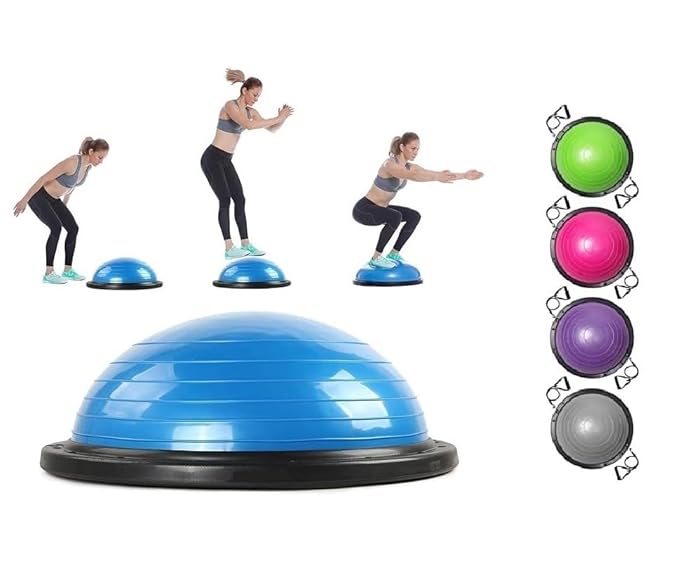
ALL-AROUND SAFETY: Made from environmentally friendly and non-toxic PVC, the non-slip base & anti-skid texture improve user stability. Wear-resistant ABS base with 6 slip-resistant feet and anti-burst technology guarantee safety during use
Balance Ball:
A Complete 2500-Word Description with Subheadings
1. Introduction to the Balance Ball
The Balance Ball, often referred to as a Stability Ball, Swiss Ball, or Exercise Ball, is one of the most versatile and effective pieces of fitness equipment in the world. Its simple structure—a large inflatable ball made of soft elastic—belies the wide range of applications it offers in fitness, rehabilitation, yoga, pilates, and office ergonomics.
Originally developed for therapeutic purposes, the balance ball has become a staple in gyms, homes, and clinics globally. Whether you’re an athlete, a physiotherapy patient, a fitness enthusiast, or an office worker seeking better posture, the balance ball can serve you in multiple ways.
2. History and Origin
2.1 Swiss Beginnings
The balance ball originated in Switzerland in the 1960s, invented by Italian plastics manufacturer Aquilino Cosani. Initially used in neurological rehabilitation by Swiss physical therapists, the ball gained popularity due to its effectiveness in aiding posture correction, muscle coordination, and strength development.
2.2 Adoption in Physical Therapy
It was later adopted by American and European physical therapists, who introduced it into mainstream therapy programs. This helped it gain the name “Swiss Ball”, even though it was made in Italy.
2.3 Mainstream Fitness
By the 1990s, balance balls had made their way into gyms and fitness centers, becoming integral tools for core training, stability workouts, and functional fitness routines.
3. Structure and Design of a Balance Ball
3.1 Materials Used
Balance balls are typically made of PVC (polyvinyl chloride) or rubber-like elastic materials. Modern balls are often anti-burst, meaning they deflate slowly if punctured rather than exploding.
3.2 Sizes Available
Balance balls come in various sizes, generally measured by diameter when inflated:
-
45 cm – Ideal for individuals shorter than 5’0” (152 cm)
-
55 cm – Suitable for people between 5’1” and 5’7” (155–170 cm)
-
65 cm – Suitable for 5’8” to 6’1” (173–185 cm)
-
75 cm – Suitable for people over 6’2” (188+ cm)
Choosing the right size is essential for correct posture and maximum benefit.
3.3 Surface Texture and Grip
Some balls have textured surfaces to improve grip and prevent slipping, especially during workouts. Others feature lines or ribbing for alignment assistance.
4. Types of Balance Balls
4.1 Standard Balance Ball
The classic version used for general workouts and physical therapy.
4.2 Peanut Ball
Shaped like a peanut, this type provides more stability and is used in birthing centers, children’s therapy, and rehab settings.
4.3 BOSU Ball
Half of a balance ball attached to a flat platform. BOSU stands for “BOth Sides Up” and is widely used in athletic training.
4.4 Burst-Resistant Ball
Designed to deflate slowly if punctured, improving safety during intense workouts or when used around sharp objects.
4.5 Ball Chair (Balance Ball Chair)
A stability ball mounted on a chair frame, often used at desks to improve posture and reduce back pain.
5. Benefits of Using a Balance Ball
5.1 Core Strengthening
Using a balance ball requires engaging your core muscles to maintain stability. Over time, this strengthens your abdominals, obliques, and lower back.
5.2 Improved Balance and Coordination
The unstable surface forces your body to adapt, improving neuromuscular coordination, balance, and reflex response.
5.3 Enhanced Flexibility
Incorporating stretching exercises on a balance ball increases range of motion and joint mobility.
5.4 Posture Correction
Regular use, especially as a chair alternative, promotes spinal alignment and ergonomic sitting, helping alleviate back and neck strain.
5.5 Injury Rehabilitation
Common in physical therapy, the ball aids in muscle recovery, joint stability, and gentle motion exercises for post-injury rehab.
5.6 Low-Impact Exercise
The balance ball supports the body during movement, making it suitable for people with joint issues or those recovering from injury.
6. Exercises You Can Do with a Balance Ball
6.1 Core and Abdominal Exercises
-
Crunches
-
Planks
-
Russian Twists
-
V-sits
6.2 Lower Body Workouts
-
Wall squats using the ball
-
Hamstring curls
-
Glute bridges
6.3 Upper Body Strength
-
Push-ups with feet on the ball
-
Chest presses
-
Shoulder stability work
6.4 Flexibility and Stretching
-
Back extensions
-
Spinal twists
-
Hip flexor stretches
6.5 Full-Body Stability Training
-
Balance ball burpees
-
Ball passes (hands to feet)
-
One-legged holds
7. Balance Ball in Specialized Fitness
7.1 Yoga and Pilates
Balance balls are frequently used in yoga and pilates for enhancing poses, providing support, and challenging balance.
7.2 Physical Therapy and Rehab
Therapists use the ball to restore muscle function, improve range of motion, and assist in neurological retraining after strokes or surgeries.
7.3 Prenatal and Postnatal Use
The ball is used during pregnancy for labor preparation, postnatal recovery, and even baby exercises. The gentle bouncing helps relax pelvic muscles and soothe infants.
7.4 Athletic Conditioning
Many sports programs use balance balls to improve proprioception, reaction time, and functional strength for athletes in sports like football, basketball, and gymnastics.
8. Using a Balance Ball as a Chair
8.1 Office Ergonomics
Sitting on a stability ball instead of a chair at a desk promotes active sitting. This encourages micro-movements that engage the core and support good posture.
8.2 Benefits of Ball Chairs
-
Improves spinal alignment
-
Reduces pressure on lower back
-
Encourages frequent posture shifts
-
Enhances alertness and focus
8.3 Drawbacks and Precautions
While beneficial, prolonged sitting without breaks can still lead to fatigue or strain. It’s important to alternate between the ball and a standard ergonomic chair.
9. Safety Guidelines for Balance Ball Use
9.1 Proper Inflation
Ensure the ball is inflated to the correct diameter. Over-inflation can make the ball too firm and unstable, while under-inflation may reduce effectiveness.
9.2 Correct Sizing
Use a ball that fits your height. When seated, your knees should form a 90-degree angle with feet flat on the ground.
9.3 Avoid Sharp Objects
Keep the ball away from pins, scissors, or anything that could puncture it.
9.4 Anti-Burst Technology
Use burst-resistant balls for added safety, especially during high-impact exercises.
9.5 Surface and Footwear
Exercise on non-slip surfaces and avoid socks or slippery shoes that may cause falls.
10. Maintenance and Care
10.1 Cleaning
Wipe the ball regularly with a damp cloth and mild soap. Avoid harsh chemicals or abrasive pads.
10.2 Storage
Store the ball in a cool, dry place away from direct sunlight to avoid material degradation.
10.3 Re-inflation
Check and maintain inflation levels, especially if you use the ball frequently or as a chair.
11. Choosing the Right Balance Ball
11.1 Consider Your Height
Refer to size charts to select the correct diameter.
| Your Height | Ball Size (cm) |
|---|---|
| < 5’0” | 45 cm |
| 5’1”–5’7” | 55 cm |
| 5’8”–6’1” | 65 cm |
| > 6’2” | 75 cm |
11.2 Consider Your Purpose
-
Fitness workouts: Standard or anti-burst ball
-
Yoga or Pilates: Slightly under-inflated for softness
-
Desk sitting: Ball with base or stability ring
-
Rehab: Peanut ball or textured surface for grip
11.3 Consider Weight Capacity
Choose a ball that supports your weight. Many quality balls support up to 300–1000 pounds depending on the brand.
12. Popular Brands and Products
Some well-known balance ball brands include:
-
TheraBand
-
URBNFit
-
Gaiam
-
Live Infinitely
Reviews
There are no reviews yet.