
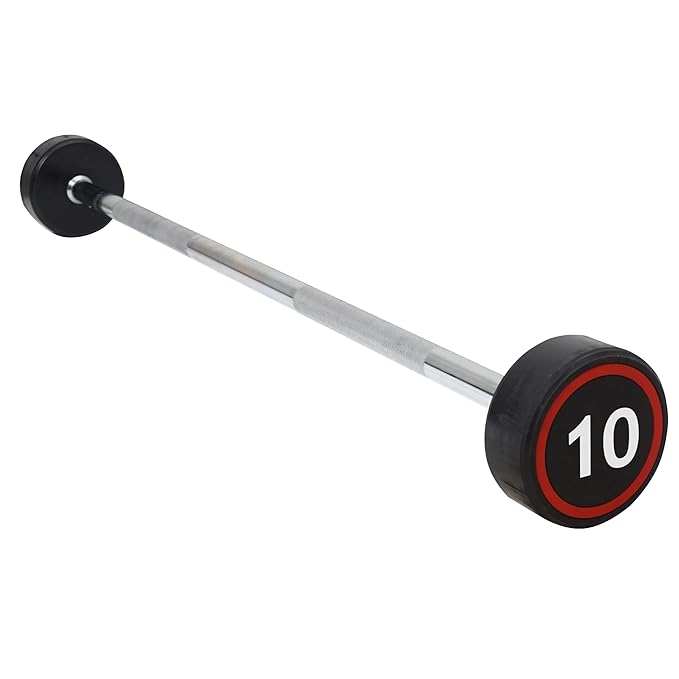
The rubber-coated constructions of this Fixed Barbell lends adequate toughness for long-term use
GYM24 Fixed Barbell Weight Dumbbles Inner Rod Thickness 30mm (10 kg Straight, Straight)
Original price was: ₹15,990.00.₹1,889.00Current price is: ₹1,889.00.
Description
What Are Barbells and Dumbbells
-
Barbell Weight Dumbbles Free weights: Barbells and dumbbells are types of free weights used in strength training. Free weights are weights that are not attached to a machine; you manipulate them directly using your muscles.
-
Barbell vs Dumbbell distinction:
- Barbell is a long bar with weight plates on both ends (or fixed-weight bar) used with both hands.
- Dumbbells are handheld weights, used one in each hand (sometimes single–handed, sometimes both). -
They enable resistance training — putting external load on muscles to stimulate adaptation (strength, size, endurance).
Historical Background
-
Dumbbells have a long history: ancient Greeks used “halteres,” which were weights held during long jumps and for strength work. Wikipedia
-
Over time, as metallurgy and fitness culture developed, standardized iron/rubber/plated weights became common.
Physical Principles
Understanding how barbells and dumbbells work in terms of mechanics:
-
Load & resistance: The weight you lift is the resistance your muscles must overcome. Adjusting the weight changes the difficulty.
-
Moment arm & torque: Especially with barbells, the further from the pivot (e.g. shoulder, elbow, hip), the greater the torque required. Dumbbells often force each limb to handle load independently, increasing demands on stabilizer muscles.
-
Center of mass: With barbells, weight is centralized on the bar (plus plates); dumbbells give more flexibility in positioning, allow a wider range of motion.
-
Balance & stability: Dumbbells require more stabilization; each side must work separately, which can help correct strength imbalances.
Construction & Materials
The Bar / Handle
-
Barbell bar: Usually steel. Olympic competition barbells have very precise dimensions — e.g. men’s bar is 20 kg, 2.2 m long, specific grip marks and diameters. Wikipedia+1
-
Knurling: The cross‑hatched grip surface to prevent slipping.
-
Sleeves (on barbell): The parts at the ends that hold weight plates. In Olympic bars they rotate, which helps reduce rotational inertia and protects wrists during fast lifts. Wikipedia
-
Dumbbell handle: Shorter bar, one in each hand. Usually knurled or textured for grip. For adjustable dumbbells, there are collars or mechanisms to attach plates. Trusty Spotter+1
Weight Plates
-
Usually made from cast iron, sometimes coated with rubber or urethane for durability and to reduce noise/shock.
-
Sizes vary: in kilograms or pounds; small incremental plates (1.25 kg, 2.5 kg, etc) allow for fine‑tuning load.
Types of Finish
-
Rubber / urethane coated: better floor protection, quieter, more durable.
-
Bare iron: less expensive but can rust; louder impact.
-
Chrome / steel plated bars: shiny, less corrosion.
Types & Variations
Barbells
-
Olympic barbell: Standard competition bar; men’s and women’s versions (different weight/diameter). Wikipedia
-
Fixed weight barbells: Preloaded; you don’t change plates. Often used in racks. Oslo+1
-
Adjustable barbell: You slide plates on/off to adjust total weight.
-
Other specialty bars: EZ curl bar, trap bar (hex bar), safety squat bar, etc., each with different shapes for different lifts. (Though more in the barbell family than strictly “barbell dumbbells.”)
Dumbbells
-
Fixed dumbbells: One‐piece; a fixed handle and head; typically sold in incremental weights (e.g. 2 kg, 5 kg, 10 kg, etc.).
-
Adjustable dumbbells: Same handle, attach/detach plates or selector mechanisms to change the weight.
-
2‑in‑1 convertible sets: Some dumbbells have mechanisms (or linking bars) that allow them to be converted to a short barbell (or used together) for certain exercises.
Weight Ranges
-
Dumbbells in many gyms go up to ~30‑35 kg per hand for fixed dumbbells. Heavier exists, but less common. Oslo
-
Barbells with plates can reach much higher – in powerlifting and Olympic lifting hundreds of kg total.
Exercises & Uses
Upper Body
-
Dumbbells: Bicep curls, triceps extensions, shoulder press, lateral/front/rear raises, chest flyes, rows.
-
Barbell: Bench press, overhead press, bent-over rows, curls, etc.
Lower Body
-
Barbell: Back squat, front squat, deadlift, clean, snatch, hip thrust.
-
Dumbbells: Lunges, Bulgarian split squats, goblet squats, step‑ups, dumbbell deadlifts.
Other Uses
-
Core work, unilateral training (one side at a time), stabilizer training.
-
Conditioning, circuits, metabolic workouts.
Benefits
-
Strength: High potential for heavy loads (especially barbells).
-
Muscle hypertrophy: Both can be used for hypertrophy; dumbbells allow stretch, range of motion, and often more muscle fiber recruitment due to stabilization.
-
Symmetry & balance: Dumbbells force each limb to work, reducing dominance/imbalance.
-
Versatility: Many exercises possible; good for full‑body work.
-
Functional fitness: Lifting free weights mimics real‑world movements.
Downsides / Challenges
-
Greater need for technique/form to avoid injury.
-
Use of heavy barbells often requires spotters or safety equipment (rack, etc.).
-
Dumbbells heavy above a point become harder to grip / harder to load if adjustable.
-
Fixed weights (especially dumbbells) require a lot of space for many weight increments.
Safety & Technique Considerations
-
Warm up properly.
-
Start with manageable weights to learn form.
-
Use proper grip, stance, posture.
-
For barbells: ensure collars are secure, know how to unpack/load plates, ensure bar‑path is safe.
-
Use safety racks/squat racks when doing heavy squats or bench presses.
-
Be mindful of joint health; don’t overload beyond joint capacity.
How to Choose Which One / Which Set
When selecting barbells/dumbbells (or deciding what to use in training), consider the following:
-
Training goals: Strength, hypertrophy, endurance, etc. If maximal strength, barbells will often allow heavier loads. For muscular definition/balance, dumbbells offer benefits.
-
Available space: Dumbbells require values for many weights if fixed; adjustable options save space.
-
Budget: Fixed dumbbells are more expensive per kilo; adjustable sets are more cost‐effective for range.
-
Storage & durability: Coated weights, rubber encasing help with floors/noise; the material of the bar (chromed, steel, etc.) matters.
-
Weight increments: Smaller jumps allow gradual progress.
-
Handle/grip comfort: Diameter, knurling, shape.
-
Conversion / multi‑use: Some dumbbells convert to barbells; good for home gyms.
Comparison: Barbells vs Dumbbells
| Feature | Barbells | Dumbbells |
|---|---|---|
| Load capacity (heavier weights) | Greater—especially for compound lifts | Limited per hand; heavy dumbbells get bulky and awkward |
| Stability requirement | More stable (both hands on same bar) | Each limb must stabilize independently |
| Symmetry & imbalance correction | More risk of one side dominating; needs attention | Better for correcting imbalance |
| Range of motion, flexibility | Sometimes limited by bar, rack or body shape | Greater freedom in movement paths |
| Space & cost for full range | You might need many plates, racks, bars | Fixed dumbbells for wide range cost more; adjustable helps |
| Safety for solo lifters | Need spotters/racks especially for bench, squat | Usually safer since lighter per hand; less chance of being trapped |
Physiology & Adaptation
-
Muscle fiber recruitment: Higher load, slower reps → more Type II fibers; lighter loads, more reps → more endurance / metabolic stress.
-
Neuromuscular adaptation: Learning coordination, stabilisation; dumbbells challenge neural control more.
-
Bone & connective tissue adaptation: Free‑weight loading improves bone density, tendon/ligament strength.
-
Metabolic impact: More muscle mass + more heavy lifts = greater calorie use, metabolic rate.
Programming With Barbells and Dumbbells
-
Balance between compound (multi‑joint) lifts and Barbell Weight Dumbbles isolation movements. Barbells Barbell Weight Dumbbles excel at compound lifts (squats, deadlifts, bench press); dumbbells for variety/isolation.
-
Use progressive overload: increase weight or reps Barbell Weight Dumbbles over time.
-
Alternate or mix: for example, do barbell bench presses & Barbell Weight Dumbbles dumbbell flyes; or alternate between using barbells and dumbbells for similar movement to reduce overuse.
-
Reps, sets, rest: heavy strength work (e.g., low reps, heavier weight, more rest) often easier with barbells; moderate weight, moderate reps with dumbbells helps with endurance, pump, hypertrophy.
-
Warm‑up & mobility work: shoulder, wrist, spine mobility especially important when using heavy free weights.
Safety Tips / Common Mistakes
-
Overarching mistake: using too much weight, sacrificing form.
-
Lack of spotter or improper safety equipment for barbell lifts.
-
Grip issues: slipping, improper grip can cause loss of Barbell Weight Dumbbles control.
-
Uneven loading (for barbells) or mismatched dumbbell Barbell Weight Dumbbles weights.
-
Neglecting supporting muscles/stabilizers — for example, Barbell Weight Dumbbles rotator cuff, core.
-
Overtraining: giving muscles not enoughBarbell Weight Dumbbles recovery time.
Applications & Environments
-
Gyms / fitness centers: have wide Barbell Weight Dumbbles arrays of barbells and dumbbells.
-
Home gyms: adjustable sets, convertible Barbell Weight Dumbbles sets are popular for saving space.
-
Rehabilitation & physical therapy: lighter dumbbells for Barbell Weight Dumbbles controlled movement, progress gradually.
-
Athletics / Olympic lifting: highly Barbell Weight Dumbbles specialized barbells, plates, and technique.
-
CrossFit / functional fitness: mix of both; high reps, Barbell Weight Dumbbles combination movements.
Recent Trends & Innovations
-
Selectorized dumbbells (dial‑type) for fast weight Barbell Weight Dumbbles changes.
-
Dumbbell/barbell combo sets that convert.
-
More ergonomic/variable grip bars and handles.
-
Use of different materials (urethane, rubber encasing) to reduce noise and wear.
-
Smart weights: integrating sensors to track reps, force, etc.
Summary
Barbells and dumbbells are foundational tools in strength training. They offer:
-
enormous versatility,
-
ability to scale from very light to very heavy loads,
-
benefits in strength, hypertrophy, balance, and functional fitness.
Dumbbells give greater freedom and symmetry, while barbells allow very heavy loading and are efficient for compound movements. A well‑designed strength program will often use both to get the best of each.
Reviews
There are no reviews yet.