
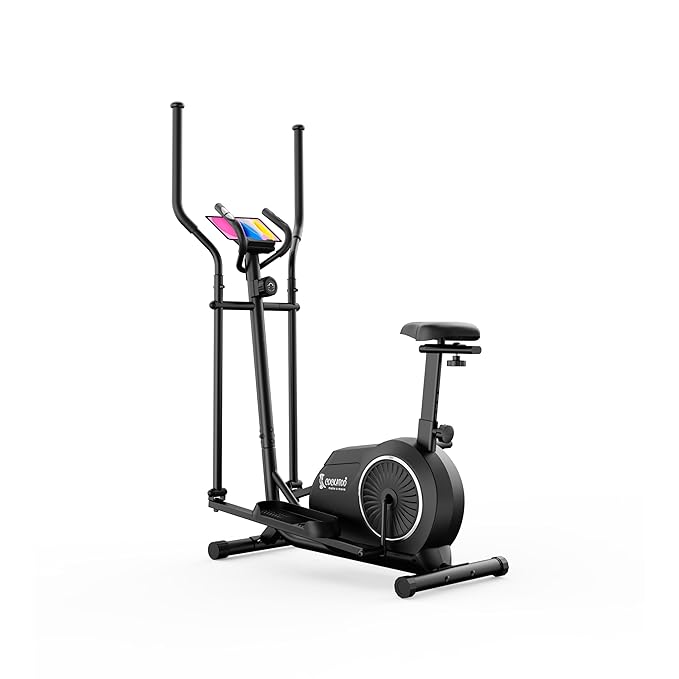
Comprehensive Console Features: Track your progress with a built-in console that displays speed, time, distance, calories burned, and pulse rate. The auto start/stop function and hand pulse sensors enhance your workout efficiency and safety.
Cockatoo Trainer-X 5Kg Fly-Wheel Elliptical Cross Trainer for Home, with 8 Levels of Resistance Exercise Equipment for Home, Max User Weight 120 Kg (Free Installation Assistance)
Original price was: ₹43,999.00.₹15,990.00Current price is: ₹15,990.00.
Description
Below is a detailed, structured description of a cross trainer for home use (also known as an elliptical trainer), covering what it is, its benefits, how it works, important features, buying considerations, pros & cons, maintenance, usage & workout tips, and ideal usage scenarios. If you want, I can also tailor this to India / your budget / brands.
What is a Cross Trainer
A cross trainer (or elliptical trainer) is a stationary fitness machine that simulates motions like walking, running, and stair-climbing, but in a low-impact way. It combines movements of the arms and legs: pedals for the lower body, handles (movable or fixed) for the upper body. The motion of the feet is usually along an elliptic (oval or elongated oval) path rather than a simple circular path as in a bicycle. The goal is to provide a cardiovascular workout with reduced stress on joints.
-
It’s “elliptical” because the pedals follow an oval path.
-
Some models have fixed handlebars; others offer moving handles so your arms also do work.
-
One of the defining advantages is that it’s low-impact compared to running or treadmill walking.
How a Cross Trainer Works
To understand how it benefits you, it helps to know how the mechanism operates:
-
Pedals / Footplates: Your feet are placed on large footplates which move in the elliptical path. The forward and backward motion propels the workout.
-
Handles / Levers: Dual-action handles move (in many models) so your arms push and pull, engaging upper body muscles (arms, chest, back), adding to the calorie burn.
-
Resistance System:
-
Magnetic resistance: Common in home models. Offers smooth, quiet adjustments.
-
Manual resistance: Simpler, less expensive; adjust via knobs or levers.
-
Air or fan resistance / hydraulic / others: Less common for home.
-
-
Flywheel or equivalent rotational mass: Helps smooth the motion; heavier flywheels tend to produce smoother, more stable motion.
-
Console / Display: Tracks metrics—time, distance, speed, calories burnt, sometimes heart rate (via sensors / strap), pulses, etc. Some machines have preset programs, Bluetooth connectivity, or even app integration.
Benefits of Using a Cross Trainer at Home
Using a cross trainer has many advantages, especially when used at home:
-
Low Impact on Joints: Because your feet never leave the pedals (no impact like jumping, running), there’s much less stress on knees, ankles, hips. Safer for people with joint issues or recovering from injury. Wikipedia+2fitnessexpostores.com+2
-
Full‑Body Workout: Arms + legs + core get engaged. Helps in toning upper body (if handles present), lower body, and improving cardiovascular endurance. Hindustan Times+1
-
Cardio & Calorie Burn: Good for weight loss, boosting the heart, improving stamina. Depending on intensity, can burn comparable calories to jogging but without the impact. Amazon India+3fitnessexpostores.com+3Hindustan Times+3
-
Convenience & Flexibility: You can use it at home, irrespective of weather, time of day. No need to commute to gym. Can be used while multitasking (watching TV, listening to music). Hindustan Times+1
-
Variable Intensity: You can do gentle walking, interval sprints, steady-state cardio, etc., by adjusting resistance and speed. Useful for beginners through advanced users. fitnessexpostores.com+1
Key Features to Look for in a Home Cross Trainer
When choosing one for home, these are the features you should pay attention to. They determine comfort, durability, effectiveness, and whether it fits your needs.
| Feature | Why It Matters |
|---|---|
| Stride Length | A longer stride gives more natural motion, less cramped feeling. If you’re tall, you’ll want longer stride; short strides may feel awkward. |
| Resistance Levels | More levels allow finer control; good for progression and varied workouts. Magnetic resistance is smoother and quieter. |
| Flywheel Size / Inertia | Heavier flywheel or higher inertia → smoother motion, less jerky. Especially important for higher intensity or long workouts. |
| Weight Capacity & Frame Strength | You want the frame to be sturdy and support more than just your body weight (since dynamic stresses happen). Also necessary to ensure long life. |
| Foot Pedals / Footplates | Width, comfort, anti-slip surface, adjustability. Wide & stable pedals are safer. Fixed incline vs adjustable pedals. |
| Handles | Moving handles for full‑body, static handles if focus is just on legs or stability. Ergonomic grip is important. |
| Console / Display & Programs | Metrics tracked; preset workouts; heart-rate monitor; integration with apps; Bluetooth; audio features; cooling fan if available. |
| Size / Footprint | Home space is limited. Measure where you’ll keep it. Consider height, width, length. Also think about clearance needed. |
| Noise Level | Magnetic resistance tends to be quieter. Important for home, especially apartments or shared walls. |
| Warranty / Support | Frame warranty, parts, service availability matter, especially if buying from a brand or store. In India: after‑sales service matters. |
Buying Considerations & What to Watch Out For
It’s easy to be swayed by looks or price, so here are things to check/decide before you buy:
-
Budget vs Use Frequency: If you’ll use daily / for long times, spend more on build, features. For occasional use, a simpler model suffices.
-
User’s Height and Weight: Ensure the machine supports your weight, and stride length works with height. If others in family will use, account for that.
-
Space / Location: Have a dedicated spot. Remember you need space around it for mounting / dismounting and safety. Ceiling height if the handles move up.
-
Power Needs: Some machines need plug‑in for display / resistance; others may have battery‑powered or self‑powered resistance.
-
Stability: Should not wobble or shake. A stable base reduces risk of injury.
-
Ease of Assembly: Sometimes takes time; check whether help or professional Cross Trainer for Home installation is provided.
-
Warranty & Spare Parts: In many parts of India, spare parts or service Cross Trainer for Home support can be limited; go with known brands or those with service network.
-
Extra Features: Bluetooth, app compatibility, ability to track progress, integration with fitness tracking etc. Are “bells & whistles” but can add motivation.
Pros & Cons
Every machine has trade-offs. Here is a Cross Trainer for Home balanced view.
Pros
-
Low joint stress (good for joints, older users, Cross Trainer for Home rehabilitation).
-
Full‑body workout + cardio + calorie Cross Trainer for Home burn.
-
Convenience of home (no travel, flexible timing).
-
Adjustable intensity; can grow with you.
-
Silent / quieter options available.
Cons
-
Cost can be significant, especially Cross Trainer for Home for high‑end features.
-
Takes space; may Cross Trainer for Home be bulky.
-
Sometimes underused if motivation drops.
-
Maintenance (e.g., moving parts, resistance mechanism) needs attention.
-
Some cheaply made models may have durability Cross Trainer for Home issues.
Maintenance & Care
To ensure longevity and safe functioning:
-
Regularly clean the pedals, track, handles — Cross Trainer for Home sweat can corrode moving parts.
-
Lubricate or oil moving parts if required by Cross Trainer for Home manufacturer.
-
Tighten screws, bolts periodically (vibration can loosen them).
-
Check for wear in footpads or belts etc. Replace worn parts.
-
Keep it in dry place; avoid exposure Cross Trainer for Home to moisture.
-
If it has electronics or display, avoid harsh cleaning chemicals; use soft damp cloth.
How to Use a Cross Trainer Effectively
Getting the best out of it is not just about buying; knowing how to use it matters.
-
Warm up first: Start with low resistance and slower pace for 5‑10 minutes.
-
Posture: Keep back straight, shoulders relaxed, core engaged; avoid leaning heavily on handles.
-
Use arms (if handles are movable): Engaging arms increases calorie burn and balances workout.
-
Vary intensity: Use intervals (alternate hard/easy), steady state, or resistance changes to avoid plateau.
-
Duration & Frequency: For general fitness, about 30 minutes, 3‑5 times a week. For weight loss, possibly more or higher intensity.
-
Cool down: Slow down gradually for Cross Trainer for Home 5 minutes, stretching legs, calves, arms.
Ideal Users & Scenarios
-
People with joint pain, recovering from Cross Trainer for Home injury, or who prefer low impact cardio.
-
Those who want a full‐body cardio machine.
-
Individuals who have irregular schedules Cross Trainer for Home and prefer being able to work out at home.
-
Families who share the machine (if height/weight/footprint permits).
-
Users who want to burn calories and Cross Trainer for Home improve cardiovascular health without putting strain on joints.
Technical / Scientific Notes
-
The elliptical motion reduces peak Cross Trainer for Home impact forces compared to running. Wikipedia+1
-
Many models allow reverse motion (pedal backwards) which engages different muscle groups. Good for variety.
-
Energy expenditure depends on your weight, resistance, speed. The more you push (higher resistance + faster cadence), the more fat/ calories burned.
Example Models & What They Illustrate
To put theory in perspective, here are a few models from India/home market to see how different machines stack up. These help illustrate choices people actually make.
-
Durafit Tango Elliptical Cross Trainer — around 100 kg user capacity; good build; 8 levels of manual resistance; LCD screen for feedback. The Economic Times
-
Cockatoo CE03Advance Smart Series — supports around 120 kg, magnetic resistance, adjustable pedals, textured foot-plates. The Economic Times+2Hindustan Times+2
-
PowerMax EH‑260S — sturdy frame, non‑slip large pedals, 8 levels resistance, LED/LCD comparing multiple metrics. Hindustan Times+1
Conclusion
A cross trainer for home is an excellent investment if you want:
-
a versatile cardio machine
-
gentle on joints
-
engaging both upper & lower body
-
something usable under varied schedules
To make your investment worthwhile:
-
Select a machine suited to your height, weight, space.
-
Pick resistance system and features you’ll actually use.
-
Make sure you can use it regularly (motivation & routine matter).
-
Maintain it well so it lasts.
Reviews
There are no reviews yet.