
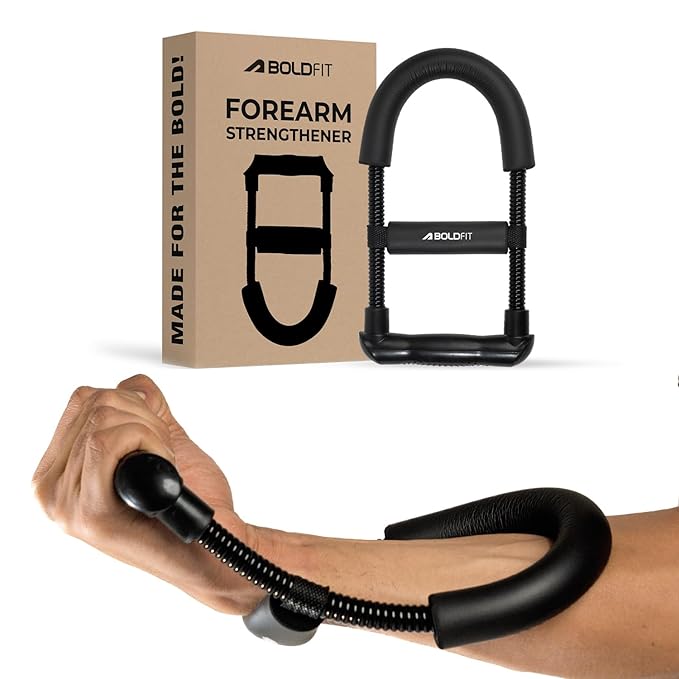
UPPER BODY WORKOUT EQUIPMENT – Boldfit forearm strengthener and wrist exercise equipment is a perfect upper body workout equipment that can be used as a gym equipment or even an at home workout equipment. It helps you gain wrist and forearm strength as a forearm strengthener, and wrist support and strengthener. If you’re interested in gaining forearm muscle grip and vein grip, it’s an ideal gym accessories.
Boldfit Forearm Strengthener Wrist Exercise Equipment Arm Strengthener Grip Strengthener Fitness Equipment Home Gym Equipment For Men & Gym Equipment For Women Grip Workout Forearm Wrist Grip, Black
Original price was: ₹699.00.₹399.00Current price is: ₹399.00.
Description
Forearm Strengtheners:
Complete Guide
1. What Is a Forearm Strengthener?
A forearm strengthener (sometimes called a wrist or grip strengthener) is any tool or exercise designed to increase strength, endurance, and control in the muscles between the elbow and wrist—especially those controlling grip, wrist flexion/extension, supination/pronation, and fine motor control of fingers. Spiegato+1
These devices can take many forms: hand grippers, wrist rollers, spring‑loaded curl devices, adjustable band or ribbon style, finger press machines, etc. Their key feature is providing resistance in motion so the forearm muscles need to work. Spiegato+2FitBeast+2
2. Anatomy: Which Muscles Are Involved
To understand how forearm strengtheners work and how to use them optimally, it’s useful to know what muscles are involved.
-
Forearm Flexors: the group of muscles on the palm side of your forearm. These flex the wrist and help with gripping (e.g. flexor carpi radialis, flexor carpi ulnaris, flexor digitorum).
-
Forearm Extensors: on the opposite side (back of the hand), these extend the wrist and help with motion that opens up the fingers / hand, pull‑ups, etc.
-
Brachioradialis: helps in elbow flexion, especially when the grip is in neutral position (hammer grip).
-
Pronators and Supinators: muscles that rotate the forearm (turning palm up or down).
-
Intrinsic hand muscles: while not strictly forearm, tools that involve fingers (finger press plates, grippers) also engage the smaller muscles of the hand.
Balancing flexor and extensor strength is important to avoid injury (e.g. tendon strains, imbalances).
3. Benefits of Using Forearm Strengtheners
Here are what you gain by adding forearm strength tools into your regimen:
3.1 Improved Grip Strength & Functional Use
Strong grip helps in many daily tasks (carrying, lifting), sports (rock climbing, tennis, golf, martial arts), and even in gym work (deadlifts, pull‑ups). Forearm strengtheners directly train gripping ability. FitBeast+1
3.2 Greater Muscular Endurance
If you train forearms, you can hold heavy objects or maintain grip for longer without fatigue. Activities like rowing, lifting, gripping tools, carrying any weight over distance become easier. FitBeast
3.3 Improved Wrist Control and Stability
Strong forearms assist in stabilizing the wrist joint, which is often a weak point, especially under load. This reduces risk of wrist injuries (sprains, strains) and supports better performance in pressing, pulling, or sports that require wrist work. Spiegato+1
3.4 Injury Prevention & Rehabilitation
Balanced strength in the forearm flexors/extensors helps prevent overuse injuries like tendonitis, carpal tunnel, and strains. Also, many forearm strengtheners are used in rehab or physiotherapy to rebuild muscle after injury. FitBeast+1
3.5 Aid in Performance & Aesthetics
Stronger forearms add to overall arm strength and visual muscularity. Also, in sports or tasks where grip is a limiting factor (climbing, martial arts, racket sports), stronger forearms can translate to better performance. FitBeast+1
3.6 Versatility & Convenience
Many forearm strengtheners are compact, portable, and can be used anywhere (home, office, gym). Some are adjustable in resistance, so they adapt as you get stronger. Amazon India+2Amazon India+2
4. Types / Designs of Forearm Strengtheners
There are many tools or devices; knowing their differences helps you pick what works best for your goals.
| Type | How It Works | Pros | Cons |
|---|---|---|---|
| Hand Grippers (spring grippers) | Squeeze handles together; resistance via spring. | Very portable; easy to use; good for grip strength. | Limited range of motion; may neglect extensors; resistance fixed unless different grippers used. |
| Adjustable Wrist / Forearm Curl Devices | Use a stabilizer pad + springs or ribbon bands to create resistance for wrist flexion/extension. Some allow reverse curls. | More versatile; can hit both flexors and extensors; adjustable resistance. | May be bulkier; comfort/safety depends on padding; need careful technique. From Indian market: “DEE Sons Forearm Strengthener … three adjustable resistance levels … stainless-steel springs and thick foam stabiliser pad for comfort.” 1mg |
| Wrist Rollers | Rope + weight, turn bar to wind rope up/down; gives both concentric and eccentric work. Wikipedia | Extremely effective for both flexors/extensors; builds endurance; variable load. | Requires space; setup; can be slower to load/unload; awkward to carry. |
| Finger‑Press / Finger‑Pad Devices | Each finger presses down separately on pads or rings; works intrinsic hand muscles + tendons. | Helps dexterity; useful for musicians, climbers; helps rehab. | Less load; slow gains; not always easy to find. |
| Band / Ribbon Forearm Exercisers | Elastic or ribbon resistance + handles or loops; wrist flexion/extension, squeeze, etc. | Adjustable, easy on joints; portable; versatile. | Less intense than heavy spring/grip devices; might not be enough for advanced strength. |
| Fixed/Multiple Resistance Gripper Sets | Sets of grippers with different resistance ratings (light to heavy). | Scalability; progressive overload. | Need multiple devices; cost; storage. |
Many commercial designs combine features (adjustable springs, foam pads, finger or wrist modes). Examples in Indian market: GreenStar, Fitsy, Strauss, etc. Amazon India+2Flipkart+2
5. How to Choose the Right Forearm Strengthener
Choosing depends on your goals, current strength, budget, comfort, and how/where you’ll use it.
5.1 Determine Your Goal
-
Grip strength (e.g. for climbing, lifting)
-
Endurance (holding, carrying)
-
Wrist control / injury prevention
-
Rehabilitation / therapy
-
Aesthetic muscle growth
5.2 Resistance & Adjustability
-
Start with moderate resistance, not max, especially if new.
-
Adjustable devices (multiple resistance levels or movable stabilizer pads) allow progressive overload. E.g., Fitsy Forearm Wrist Exerciser has adjustable foam stabilizer pad to increase or reduce resistance. Amazon India
-
Spring strength, material quality matter (steel springs vs mild ones) for durability.
5.3 Comfort & Ergonomics
-
Foam or padded handles / stabiliser pads help with comfort during use. Several models (e.g. Strauss) offer foam handles to reduce discomfort. StraussSport
-
Grip size, shape should match your hand size; poor grip geometry leads to wrist strain.
5.4 Durability & Material
-
Springs should be high quality stainless steel or comparable, resistant to rust.
-
Handles: foam, rubber, or textured grips to avoid slipping.
-
Components like ribbon/resistance bands should resist tearing.
5.5 Portability and Storage
-
If you travel or want to carry in bag, go with smaller compact models or grippers.
-
If for home/gym and space isn’t issue, larger / more versatile options are fine.
5.6 Price & Value
-
Cheaper devices are good for beginners, but may not last or offer enough resistance.
-
Mid‑range often gives better materials, adjustability, comfort.
-
Premium options may include more resistance, high build quality.
6. How to Use Forearm Strengtheners Safely & Effectively
Using them correctly is key for progress and avoiding injury.
6.1 Frequency & Rest
-
For new users: 2‑3 times per week is typical. Allow rest days between sessions to let muscles recover. FitBeast
-
As strength improves, you might use more frequently or for shorter sessions.
6.2 Reps, Sets, Progression
-
Start with lighter resistance / fewer reps—don’t try heavy immediately.
-
Example: 2‑3 sets of 10‑15 reps, or holds/squeezes of 10‑20 seconds; adjust as you improve.
-
Increase resistance, reps, or duration gradually. Use adjustable devices to increase difficulty.
6.3 Variations & Balanced Training
-
Train both flexors (wrist curl) and extensors (reverse wrist curl).
-
Include pronation and supination if your tool allows it (rotating motions).
-
Use different grip widths or handle types (thick grip vs narrow).
-
Include finger strength and control using finger presses or finger pads.
6.4 Warm‑Up & Stretch
-
Warm up wrists, forearms lightly before using strengtheners (e.g. wrist circles, light dynamic stretching).
-
After training, perform static stretches for forearm flexors/extensors to maintain flexibility.
6.5 Avoid Overuse & Listen to Pain Signals
-
Discomfort or mild soreness is fine; sharp pain, tingling, numbness is not.
-
If you feel pain in tendon areas (e.g. elbow, wrist), reduce intensity or rest.
-
Sometimes soreness in muscle belly is expected; tendon discomfort is warning.
7. Common Mistakes and How to Avoid Them
Knowing pitfalls helps make your training safer and more effective.
| Mistake | Why It Happens | How to Fix It |
|---|---|---|
| Using too much resistance too early | Overconfidence; wanting fast results | Start with lighter tool; prioritize control; increment gradually. |
| Focusing only on flexors / grip and neglecting extensors | Easier / feels more satisfying; lack of awareness | Add reverse wrist curls; extensor‑focused movements; balance training. |
| Poor wrist alignment / posture | Bad grip shape; fatigue; not paying attention | Keep wrist neutral; avoid bending the wrist excessively; stop when form breaks. |
| Overtraining / no rest | Enthusiasm; underestimating rest importance | Schedule rest days; monitor soreness; reduce frequency if joints ache. |
| Swallowing pain | Ignoring signals; pushing through hurts | Stop when pain sharp or radiating; ice, rest, possibly consult medical professional. |
| Neglecting grip width & variation | Using only one tool or one grip width | Use different handles; incorporate grippers, rollers, curls with dumbbells. |
8. Sample Routines & Progressions
Here are sample routines you can follow depending on your level (beginner → advanced) and specific goals.
Routine A: Beginner (Grip & Endurance)
| Day | Exercise | Reps / Duration | Notes |
|---|---|---|---|
| 1 | Basic Hand Gripper – light resistance | 2‑3 sets × 10 squeezes per hand | Rest 30‑60s between sets |
| 3 | Forearm Strengthener (wrist flexion) | 2 sets × 12 reps | Moderate resistance |
| 5 | Reverse Wrist Curls (use dumbbell or device) | 2 sets × 10 reps | Ensuring extensor work |
Repeat weekly; increase reps when 12 becomes easy.
Routine B: Intermediate (Muscle & Strength)
-
Use adjustable device (spring or wrist strengthener)
-
Include gripper work, wrist flexion + extension, pronation/supination
-
Example:
-
Warm‑up wrists & forearms (5 mins)
-
Gripper: 3 sets × 12‑15 reps (heavy resistance)
-
Wrist flexion with device: 3 × 12 reps
-
Reverse wrist curl: 3 × 10 reps
-
Forearm roller / wrist roller (if available): 2 × roll up/down with weight
-
Cool down: stretching flexors/extensors
-
Routine C: Advanced (Power / Sport Specific)
-
Add holds, carries (farmer’s walks), thick bar grip, heavy grippers
-
Use different grip tools (finger presses, pinch grips)
-
Example:
-
Warm up
-
Heavy gripper – maximal effort (3‑5 reps)
-
Reverse gripper or extensor plate work – 3 x 12 reps
-
Wrist roller with weighted load – 3 roll‑ups / roll‑downs
-
Static holds: pinch grip or thick grip bar – 3 × 30‑60 secs
-
Finish with stretching
-
9. Tracking Progress & Measuring Success
To see that your work is paying off, and to avoid plateaus:
-
Keep a training log: note device used, resistance level, number of reps/sets, rest time.
-
Periodic testing: check maximum squeeze strength, how long you can hold a grip, or time until fatigue.
-
Visual / functional clues: less fatigue in hands during other workouts; improved performance in sports; better endurance of grip across day‑to‑day tasks.
-
Adjust when current resistance or reps become too easy (progressive overload).
10. When & Who Should Use Forearm Strengtheners
10.1 Athletes & Sports People
-
Rock climbers, racket sports (tennis, badminton), martial artists benefit greatly.
-
Powerlifters / weightlifters / CrossFit athletes: grip is often a limiting factor—strong forearms help with deadlifts, pull‑ups, etc.
10.2 Occupational / Hobby Use
-
Musicians (guitar, piano, drums) especially need finger, wrist endurance.
-
Professionals who use tools requiring grip or repetitive motion (mechanics, carpenters).
10.3 Rehabilitation & Physical Therapy
-
After wrist/forearm injuries, tendon issues, surgeries. Devices with adjustable resistance are especially useful.
-
Also helps with managing overuse injuries, tendonitis, repetitive strain.
10.4 General Fitness Enthusiasts
-
Even if forearms aren’t your main goal, stronger forearms improve performance in compound lifts, reduce fatigue in workouts, help with daily tasks.
10.5 Who Should Be Cautious / Avoid
-
People with existing wrist/forearm pain like severe arthritis, severe tendonitis, or recent injuries should consult medical advice before heavy use.
-
Avoid tools or resistance which cause sharp pain.
11. Common Myths & Misconceptions
Clearing up some misunderstandings.
-
Myth: Forearm strengtheners only build size → Actually, they build strength, endurance, grip, control; muscle size may increase but isn’t the only benefit.
-
Myth: More reps always better → Too many reps with heavy resistance (especially for beginners) can cause overuse injuries. Balance reps, rest, and resistance.
-
Myth: Only grippers are needed → Grippers train flexors primarily; extensor muscles, pronation/supination, wrist control also need work.
-
Myth: Forearm tools suffice without proper technique → Good form matters; also, warm‑up, stretching, rest are essential.
12. Safety, Injuries & Precautions
-
Warm up before heavy or high‑repetition forearm work.
-
Use proper wrist alignment (neutral), avoid twisting or bending wrists excessively.
-
If you feel tingling, numbness, or pain in wrist or elbow, stop, rest, and consider seeking professional advice.
-
Avoid overuse: muscles need rest to adapt, recover.
-
Use lighter resistance or slower tempo if you experience discomfort.
13. Case Study / Sample Growth Timeline
Here’s an example of what one might expect using a forearm strengthener regularly over weeks:
| Week | What to Do | Expected Results |
|---|---|---|
| Weeks 1‑2 | Begin with lighter resistance; 2‑3 times per week; focus on form; 2 sets × 10‑12 reps; include flexion & extension | Notice mild soreness, improvement in grip fatigue; better control; small increase in reps possible |
| Weeks 3‑4 | Increase resistance; add extensor‑focused work; maybe include a wrist roller or static holds | Reduced fatigue in grip during workouts; improved performance in pull‑ups or tools; possibly visible forearm definition |
| Weeks 5‑8 | More advanced overload; heavier resistance, more varied grip types; longer holds; higher intensity | Significant grip strength gains; better endurance; possibly muscular growth; less risk of fatigue / injury in other arm work |
| Beyond 8 weeks | Maintain, periodize (e.g. lighter / heavier weeks); integrate into overall strength program | Long term strength, robustness in wrist/forearm; transferable benefits to other lifts and tasks |
14. Integrating Forearm Strengtheners into Your Overall Training
Forearms often are a “little guy” in overall arm work; integrating them smartly ensures they help, not hinder your broader training.
-
Put forearm work at the end of workouts so that grip fatigue doesn’t reduce performance in compound lifts (deadlift, pull‑ups).
-
Or dedicate one day to grip/forearm if grip Forearm Strengthener strength is a major goal.
-
Alternate heavy and light forearm sessions Forearm Strengthener (heavy / fewer reps vs light / more reps).
-
Pair with wrist and elbow strengthening, and stretching to keep joints healthy.
-
Use tools variably: sometimes grippers, other days wrist rollers, other days grip holds or pinch grips, so you don’t overuse one movement pattern.
15. Forearm Strengthener Tools / Product Examples
To illustrate real‑world tools (especially Indian‑market ones) Forearm Strengthener and what to look for.
-
DEE Sons Forearm Strengthener and Wrist Exerciser, Black: three adjustable levels; stainless steel springs; foam stabiliser pad for comfort. Ideal for wrist, fingers, forearms. 1mg
-
Fitsy Adjustable Forearm Strengthener Wrist Exerciser: dual‑action capability (regular & reverse wrist curls), heavy‑duty spring, foam stabilizer pad. Amazon India
-
Strauss Wrist / Forearm Strengthener: spring Forearm Strengthener‑loaded steel core covered with soft foam; multi‑functional; sweat absorbent handles. StraussSport
-
GreenStar Adjustable Forearm Strengthener: heavy steel spring; thick foam grip; adjustable stabilizer ribbon; good value option. Flipkart
These show what’s available and what features are common (spring, foam grip, adjustable resistance, portability).
16. Tips for Maximizing Effectiveness
-
Progressive Overload: As with any strength work, Forearm Strengthener gradually increase resistance, duration, or difficulty.
-
Tempo Variation: Slow, controlled movements (especially the lowering / eccentric phase) helps build strength and resiliency.
-
Include Different Grip Types: Thick grip, pinch grip, finger presses—all help vary stimulus.
-
Recovery: Light massage, stretching, foam rolling of forearms Forearm Strengthener if needed; rest days.
-
Nutrition & Rest: Muscle strength gains require adequate protein, rest, sleep.
17. Summary & Key Takeaways
-
Forearm strengtheners are versatile tools to build grip, wrist, and Forearm Strengthener forearm strength, endurance, and control.
-
Benefits go beyond aesthetics: functional grip, injury prevention, Forearm Strengthener better performance in sports or heavy lifts.
-
Choose device based on your goal, strength, budget, comfort: adjustable Forearm Strengthener resistance, padding, types (gripper, roller, etc.).
-
Use proper technique: include both flexors & extensors, avoid overuse, Forearm Strengthener listen to pain signals.
-
Be consistent; track progress; integrate with overall training.
Reviews
There are no reviews yet.