
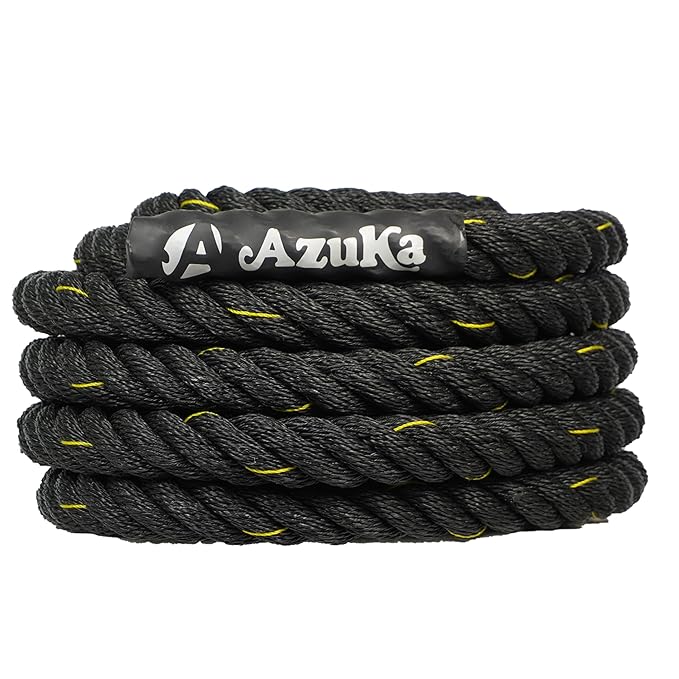
Durable Polypropylene for Intense, Long-Lasting Use
AZUKA® Heavy Battle Rope – 15FT x 1.5″ Polypropylene | Gym & Home Workout Rope | Strength, HIIT & Crossfit Training | Black Yellow
Original price was: ₹4,000.00.₹1,699.00Current price is: ₹1,699.00.
Description
What is a Heavy Battle Rope
Battle ropes (also called battling ropes, heavy ropes) are thick, long, and heavy ropes used in fitness and strength‐conditioning programs. They’re designed to be anchored at one end while the user holds the other(s) to generate waves, slams, pulls, or other dynamic movements. Wikipedia+2Healthline+2
Depending on the design, they may be made of synthetic materials like poly‐Dacron, manila, or other durable fibres; some even have flexible metal‐core variants. Wikipedia+1
Heavy battle ropes are thicker and/or longer, which increases their weight, resistance, and inertia. Because of this, they require more strength, more effort, and more coordination to move, making them more challenging than lighter ropes. TRX Training – United States+3Nike.com+3Wikipedia+3
Key Physical Characteristics
Understanding the specifications of heavy battle rope helps in selecting the right one, and using it properly. Key features include:
| Feature | Typical Range / Aspects | Effect of Increasing It |
|---|---|---|
| Diameter / Thickness | Common diameters: around 25 mm (≈1″) up to 44 mm or more. Wikipedia+1 | Thicker ropes are harder to grip, move slower, impart more resistance; demand more forearm, upper‐body strength. Nike.com+1 |
| Length | Ropes are often 5 m, 10 m, 25 m in gyms; others even 30‑50 feet (~9‑15 m) depending on space. Wikipedia+2Nike.com+2 | Longer rope gives more room for waves, more “slack,” greater amplitude; greater inertia; harder to control. Shorter rope reduces slack, easier to manage but may reduce scope for large wave/swing. Nike.com+1 |
| Material | Fibres like polypropylene, poly Dacron, natural fibres, or mixed; metal‑core options exist. Wikipedia+2Bells of Steel+2 | Affects durability, grip feel, abrasion, weight, how they respond (bounce, damping). Plastic coatings, sleeves at ends are common to protect hands/wear. |
| Anchor/Handle Ends | Ends may have handles, sleeves; anchor point can be a wall, post, heavy object. Nike.com+1 | Proper anchoring is important to safety and to optimize the rope action. |
How Heavy Battle Ropes Work (Mechanics & Physiology)
Heavy battle rope movements are unique because they combine elements of:
-
Inertia & Force Transmission: Moving a heavy rope in waves or slams creates opposing forces. The muscles must produce enough power to overcome inertia, accelerate the rope, decelerate it (especially during slams), and control recoil/slack.
-
Full‑Body Engagement: Even though you’re holding the rope with hands/arms, much of the effort comes from core stabilization, leg drive, hip hinge/squat, back, shoulders—and even grip strength. Healthline+1
-
Cardiovascular Stress: Due to continuous, dynamic movement involving large muscles, heavy ropes raise heart rate quickly, provide cardio as well as strength stimulus. Healthline+2TRX Training – United States+2
-
Metabolic Demand and Afterburn: Heavy rope workouts often induce high metabolic stress, meaning your body continues to burn calories after the workout (the excess post‑exercise oxygen consumption, EPOC). ardentfitness.com+1
Benefits of Heavy Battle Rope Training
Using heavy battle ropes offers a wide array of fitness benefits. Some of the major ones:
-
Full‑Body Strength
The waves, slams, pulls require strength not only in arms and shoulders but also in core, back, hips, legs. The core has to stabilize the body while resisting the forces caused by the rope’s momentum. Healthline+2Bells of Steel+2 -
Cardiorespiratory Fitness / Conditioning
Because of the intensity, heavy rope work significantly elevates heart rate and breathing, providing cardio benefits. Some studies show even short sessions (e.g. ~10 min) yield measurable improvements. Healthline+1 -
Muscular Endurance and Fatigue Resistance
Repeated rope waves or slams fatigue muscles—especially smaller stabilizers and grip muscles. Over time, training with heavy ropes increases endurance of these muscles. Healthline+1 -
Power and Explosiveness
Slamming the rope, fast alternating waves, explosive actions demand high power output. These help improve speed and explosiveness which is useful for athletic performance. Healthline+1 -
Low Impact
Heavy rope movements allow high intensity without high impact on joints — because you’re not jumping, running (on concrete), or subjecting joints to large repetitive shocks. Good option if you have joint concerns. Healthline+1 -
Improved Grip Strength
Large diameters + heavy ropes + continuous work = your hands/forearms get taxed significantly. Good carryover to other lifts and everyday tasks. DMoose+1 -
Core Stability and Mobility
As you generate waves from hands/arms, the core must stabilize against lateral, rotational, and anti-rotational forces. Also, using full range of motions improves mobility (shoulders, hips, spine) with consistent practice. battlerope.com.au+1 -
High Caloric Burn & Improved Body Composition
Because you’re using large muscle masses in dynamic movement with high heart rate, you burn more calories during the workout. With regular training, this can help reduce fat, improve lean muscle proportion. And due to EPOC, the metabolic rate remains elevated for some time after. ardentfitness.com+1 -
Mental Toughness / Motivation
Heavy rope workouts are physically demanding; lasting through the burn, fatigue, pushing through an intense routine builds mental resilience. Some people find the dynamic, visceral nature of slams/waves more engaging/motivating. TRX Training – United States+1
Types of Exercises / Movements with Heavy Battle Ropes
To get maximum benefit, there are various movements. Some common ones include:
| Movement | Description | Primary Muscles & Effects |
|---|---|---|
| Double‑arm waves | Both arms alternate up/down or both up/down simultaneously to create waves in the rope. | Shoulders, lats, arms, core; generates rhythm, works endurance. |
| Alternating waves | One arm moves, then the other, in alternating fashion; keeps continuous motion. | Obliques more engaged (anti‑rotational), improved coordination. |
| Slams | Lift both ends overhead (or up) then slam down. Can be two arms simultaneously. | Explosive power; core work; often a full body action if done with leg drive. |
| Pulls | Pull rope toward you, either with both hands or alternating, sometimes adding weight or dragging. | Back, shoulders, grip; sometimes legs and core. |
| Side to side waves / lateral movements | Move arms side‑to‑side to generate waves laterally. | Works shoulders, core stabilization, hip engagement. |
| Circles / Rotational waves | Move rope in circles or arcs. | Good for shoulder mobility and rotational core strength. |
| Incorporating legs / movement | Squat, lunge, rotate while doing waves/slams. | Increases lower body involvement, increases total work, more metabolic demand. |
Choosing the Right Heavy Battle Rope
Because “heavy” can mean a lot of different things, choice depends on your current strength, space, goals. Here are factors and guidelines:
-
Skill level & strength: If you’re fairly new to battle rope work, start with a lighter rope (smaller diameter or shorter length) so you can master technique before scaling up. Trying to move a rope that’s too heavy often leads to bad form or injury. Nike.com+1
-
Length vs space: The longer the rope, the more space you need. Also, longer ropes need more control. If your gym or home has limited space, a shorter but thicker rope may be more appropriate, though that increases weight per length unit.
-
Diameter: Thicker rope = harder to grip, more resistance. If grip strength is a weak point, you might want to moderate diameter.
-
Anchor point: Must be stable and strong enough to handle force. Poor anchoring can cause unsafe whipping or recoil.
-
Material & durability: If used outdoors often, you’ll want weather‑resistant material. Ends should have protective sleeves or handles to prevent fraying.
-
Portability / storage: Heavy rope can be bulky to store; check whether it comes with strap/anchor kit; whether it coils neatly; whether you can easily transport it if needed. Heavy doesn’t just refer to mass but also to unwieldiness.
Safety, Technique, and Common Mistakes
To get the benefits without injury, technique is essential. Below are key safety points and pitfalls to avoid.
Safety & Form Tips
-
Posture: Keep back neutral (not rounded). Hips back, knees slightly bent (e.g., partial squat) to help absorb forces, stabilize.
-
Core engaged: Tighten core, brace abs and lower back. Resist excessive rotation unless the movement calls for it intentionally.
-
Grip: Use a secure grip. Don’t over‑grip (which causes premature fatigue in forearms). Use hands in a way that you can hold the rope securely without tearing up palms (gloves or grip‑aids if necessary).
-
Controlled movements: Even when doing powerful slams, maintain control. Don’t just fling the rope wildly; control the descent; control the recoil.
-
Anchor safety: Anchoring point must be stable, fixed, safe. The rope must be secured so it won’t slip or break. Rope ends, sleeves must be intact to avoid frays.
-
Progression: Increase intensity (duration, rope heaviness, speed) gradually. Don’t start with long high‑intensity intervals too early.
-
Warm‑up: As with any intense exercise, warm up shoulders, arms, back, core, hips. Include dynamic mobility.
-
Rest & recovery: Heavy rope work can cause muscle soreness, especially in small stabilizers and forearms. Allow rest between sessions; manage volume.
Common Mistakes
-
Using rope that is too heavy or long before technique is solid → leads to poor form, compensations, risk of injury.
-
Letting shoulders “creep up” toward ears, using arms alone rather than whole body.
-
Standing too upright or locking knees; not using leg/capacity of body to absorb force, leading to stress on lower back.
-
Moving rope “too fast” at cost of control → losing power, wasting effort, increasing risk.
-
Ignoring grip fatigue → sometimes grip becomes limiting factor; people push too far, suffer overuse.
Programming Heavy Battle Rope Workouts
To utilize battle ropes effectively in a training program, think about when, how often, how long, what intensity, and how they fit with other training.
-
Frequency: 1‑3 sessions per week is common, depending on intensity and your overall training plan. Heavy rope work can be taxing; allow enough recovery.
-
Duration & intervals: Early on, short bursts (20‑30 seconds) work, with rest (20‑40 seconds). As you adapt, increase work time (e.g. 45‑60 sec) or decrease rest; longer intervals for conditioning. Nike.com+1
-
Integration with other training: Use as part of circuit (with strength, mobility, cardio), or as a finisher. Alternatively, pair with lower body or strength work.
-
Progression: Increase weight/heaviness of rope (by changing diameter or length), increase speed, increase duration, vary movements (slams, pulls, lateral), incorporate more dynamic / multi‑joint movements. Change rest times.
-
Specific vs general use: If training for performance (sports), choose movements that mimic sport‑specific dynamics (e.g., explosive waves, rotational work). For general fitness/composition, vary movement types to cover full body.
Application Scenarios
Here are some ways heavy battle ropes are used across contexts:
-
Sports / Athletic Training: To develop explosiveness, conditioning, core strength, grip strength (e.g. for football, combat sports, martial arts).
-
High Intensity Interval Training (HIIT): Battle‑ropes intervals are great for metabolic conditioning without heavy impact.
-
Rehabilitation / Prehabilitation: Lighter rope work (with correct technique) used to rebuild shoulder, core or grip strength; improve mobility.
-
General Fitness / Fat Loss: To burn calories, improve body composition, engage full body.
-
Home / Outdoor Training: Because ropes are relatively simple equipment, they can be used in minimal‑equipment settings (yard, garage, park) so long as anchor and space are adequate.
Considerations & Limitations
While battle ropes are very effective, they are not a panacea. Some limitations to keep in mind:
-
Grip/forearm fatigue may limit session duration or intensity before larger muscles get fully taxed. If grip fails first, whole exercise Heavy Battle Rope suffers.
-
Space requirement: You need Heavy Battle Rope enough anchoring room and slack to swing the rope. Short ceilings, crowded gyms, or poor anchor points can limit effectiveness.
-
Not a substitute for heavy loading: For maximal strength (e.g. 1‑rep max lifts, hypertrophy with large weights), battle ropes are supplemental. They aren’t typically used to replace barbell/dumbbell work for large muscle hypertrophy or maximal strength.
-
Potential for overuse or strain if used excessively or with poor technique — especially shoulders, lower back, grip, forearms.
Sample Heavy Battle Rope Workout Heavy Battle Rope
Here’s a sample structure of a heavy battle rope session for intermediate users. You can adapt based on fitness level or goals.
| Segment | Duration / Reps | Movements | Notes |
|---|---|---|---|
| Warm‑up | 5‑10 min | Dynamic mobility (shoulders, hips, wrists), light cardio, light rope waves (low intensity) | Get ready; avoid starting cold with heavy ropes. |
| Main Interval Block | 4‑6 rounds | e.g. 30 sec double‑arm waves → 15 sec rest; 30 sec alternating waves → rest; 30 sec slams → rest | Aim for high intensity but maintain good form; adjust rest if needed. |
| Strength/Power Add‑on | 3 sets | E.g., double‑arm slams (10 reps) + pull downs / pulls (10 reps) | Combine rope power work with strength elements. |
| Mixed Movement Finisher | 2‑3 rounds | e.g. lateral waves + squats; or waves with lunges; or jump‑slams | To raise metabolic demand, engage lower body. |
| Cool‑down / Stretch | 5‑10 min | Slow movement, static stretching (shoulders, back, arms, hips) | Aid recovery, reduce soreness. |
Heavy Battle Rope Compared with Alternatives
It helps to think how heavy battle ropes stack up against other training tools:
| Tool / Modality | Strengths Compared to Battle Ropes | Weaknesses / Where Battle Ropes Underperform |
|---|---|---|
| Dumbbells / Barbells | Better for maximal strength, isolated muscle work, progressive overload with precise weight. | Battle ropes offer dynamic, conditioning, metabolic, full‑body work; more joint‑friendly; greater variety in movement. |
| Kettlebells / Sandbags | Good for explosive movements, dynamic load; some overlap with rope slams, etc. | Ropes allow continuous variable resistance, wave dynamics; more motor control / endurance challenge. |
| Cardio (running, cycling) | Battle ropes combine cardio + strength; more variety and able to stress upper body better. | For long steady-state aerobic endurance specifically (like long runs), ropes may be less efficient. |
| Bodyweight / Calisthenics | Bodyweight has low equipment cost, can be effective; overlaps with rope work when adding movement. | Battle ropes allow adding external resistance and fast, high‑intensity movements not easily replicated by bodyweight alone. |
Summary
Heavy battle ropes are a powerful tool in strength, conditioning, and fitness because of their ability to combine:
-
resistance + dynamic movement Heavy Battle Rope
-
full‑body engagement Heavy Battle Rope
-
high metabolic and cardiovascular demand Heavy Battle Rope
-
power, endurance, and grip work Heavy Battle Rope
-
adaptability to many fitness levels Heavy Battle Rope
When chosen properly, mastered with good form, integrated intelligently into a training program, heavy battle rope work offers huge benefits. However, like any tool, effectiveness depends on careful progression, attention to technique, adequate rest and recovery, and aligning usage with goals.
Reviews
There are no reviews yet.