
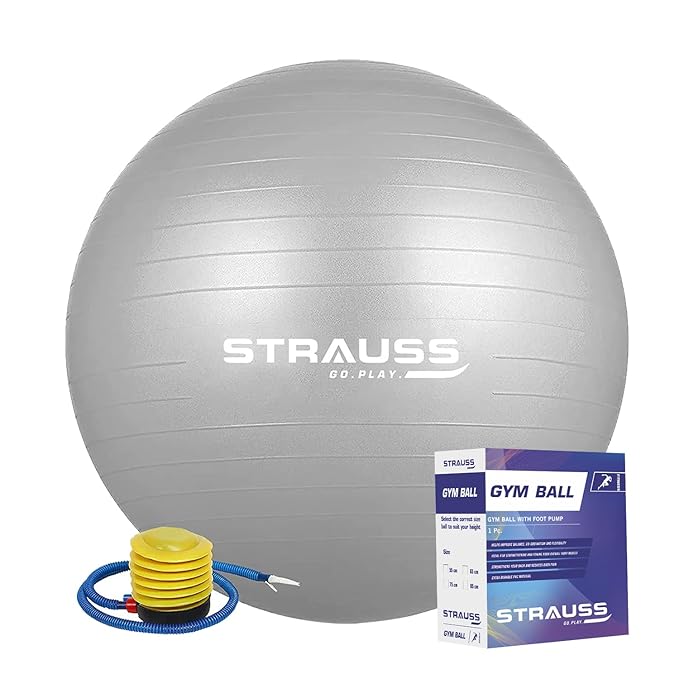
ANTI BURST & SLOW DEFLATION – Our exercise ball is made with the fine structure which makes it deflate slowly and burst resistant if punctured, thus reducing the risks of injury due to falls to the ground and offering you the most caring protection. This anti burst gym ball, the ball will provide broad base while doing workouts & will easily absorb heavy body weights is well.
STRAUSS Anti-Burst Rubber Gym Ball with Free Foot Pump | Round Shape Swiss Ball for Exercise, Workout, Yoga, Pregnancy, Birthing, Balance & Stability, 55 cm, (Grey)
Original price was: ₹1,275.00.₹679.00Current price is: ₹679.00.
Description
Below is a detailed, structured description of a Rubber Gym Ball (~2500 words), with subheadings to cover its features, uses, benefits, variations, selection guide, maintenance, safety, and possible drawbacks.
Rubber Gym Ball
A rubber gym ball (also known broadly as an exercise ball, stability ball, Swiss ball, fitness ball, physio ball) is a large, inflatable spherical tool commonly used in fitness, rehabilitation, Rubber Gym Ball yoga, pilates, core stability training, and general wellness. Crafted from durable rubber or elastomeric materials, it Rubber Gym Ball provides an unstable surface which engages multiple muscle groups to maintain balance, synergy, and posture. This description Rubber Gym Ball explores every facet of the rubber gym ball: its construction, functionality, advantages, types, how to choose Rubber Gym Ball one, how to use and care for it safely, and what limitations or drawbacks to watch Rubber Gym Ball out for.
1. Material & Construction
1.1 Materials Used
- PVC / Vinyl: Many gym Rubber Gym Ball balls are Rubber Gym Ball made from polyvinyl chloride (PVC), which is cost-effective and durable. High-quality Rubber Gym Ball PVC is thick, Rubber Gym Ball phthalate-free (if marketed “non-toxic” or “eco-friendly”), and able to withstand weight and Rubber Gym Ball pressure without Rubber Gym Ball deformation.
- Rubber / Natural Rubber / Elastomer Blends: Balls that use natural or synthetic rubber may offer better elasticity and more bounce. Pure rubber is more Rubber Gym Ball resilient, though heavier. Sometimes mixed materials (rubber & PVC or rubber & polymer blends) are used to balance durability, Rubber Gym Ball flexibility, cost, and weight.
- Anti‑Burst Materials: Premium rubber balls often incorporate anti‑burst features—meaning that if the ball is punctured or overloaded, it deflates gradually rather than bursting suddenly, for safety.
1.2 Size & Dimensions
Gym balls come in various diameters typically ranging from 45 cm up to 85 cm or more, with common standard sizes being 55 cm, 65 cm, and 75 cm. The correct size depends on the user’s height and intended usage.
- Smaller sizes (45‑55 cm) suit shorter people or for Rubber Gym Ball specific targeted exercises.
- Mid‑sized (65‑75 cm) are more universal for average Rubber Gym Ball height individuals.
- Large‑size balls (85‑100 cm) can be used for taller Rubber Gym Ball users or for rehabilitation settings.
1.3 Load Capacity
Rubber gym balls are rated for a certain weight or load limit. Standard ones may support 200‑300 kg (440‑660 lbs) static (non‑dynamic) loads; “heavy duty” or professional ones may support more. The rating matters especially when performing exercises involving movement or bouncing.
1.4 Surface & Texture
- Smooth vs Textured: Smooth surfaces are easier to clean; textured or ribbed surfaces (with dimples or grooves) can offer better grip, especially in sweaty or slippery conditions.
- Matte vs Glossy Finish: A matte or semi‑matte finish tends to be less slippery; glossy finishes may look nice but can be slick.
- Color & Visual Markings: Many come in bright colors (blue, silver, red, black, neon), or dual‑tone for visual appeal. Some have alignment lines, diameter markings, or safety warnings printed.
1.5 Inflation Valve & Accessories
- Valve Type: Ball includes a one‑way inflation valve, often with a plug or stopper. Higher quality buttons may have locking mechanisms to prevent slow leaks.
- Pump: Balls are usually supplied with a hand or foot pump. Sometimes electric pumps are used.
- Repair Kit: Good sets include a patch/repair kit for small punctures.
2. Function & Uses
A rubber gym ball serves multiple functions. Because of its unstable, pliable surface, it challenges the body differently from flat, rigid surfaces.
2.1 Core Stabilization & Balance Training
- Sitting, kneeling, or lying on the ball forces core muscles (abdominals, obliques, lower back, pelvic floor) to work continuously to maintain balance.
- Exercises like planks with feet or forearms on the ball, or abdominal crunches performed on top of the ball, intensify the challenge.
2.2 Flexibility & Mobility
- Using the ball to stretch: e.g., back extension (lying over the ball), chest opening (lying face up, arms wide), hip flexor stretches with one leg over the ball.
- Helps mobilize the spine, shoulders, hips, and promote better joint range of motion.
2.3 Strength Training Support
- Acts as a bench substitute or support surface for weight exercises. For example: dumbbell presses while lying on the ball, or using it to support the legs or upper body.
- Some exercises incorporate it directly: wall squats with ball, push‑ups with hands or feet elevated on the ball.
2.4 Rehabilitation & Physical Therapy
- Used widely in physiotherapy to retrain posture, balance after injury, to build muscle strength gently.
- Useful for patients recovering from spinal injuries, knee surgeries, or for people with weak core stability.
2.5 Yoga, Pilates, and Mind‑Body Practices
- Adds an element of instability, increasing engagement of stabilizing muscles.
- In Pilates, for example, balls are used in “ball bridging,” “swan on the ball,” “roll‑overs,” etc.
- In yoga flow, ball can assist in backbends, supports for restorative postures, or inversions.
2.6 Ergonomics & Office Use
- Some people use large exercise balls as seat substitutes (ball chairs) to promote active sitting.
- Sitting on a gym ball instead of chair forces micro‑movements of the core and pelvic muscles, improves posture, may help reduce lower back pain.
3. Health & Fitness Benefits
Using a rubber gym ball regularly brings many physiological, functional, and psychological benefits.
3.1 Core Strength & Posture
- Continuous activation of core muscles (deep abdominals, multifidus, pelvic floor) helps stabilize spine, improving posture.
- Can reduce lower back pain by improving trunk control and reducing compressive loads or asymmetries.
3.2 Balance, Coordination & Proprioception
- Working on an unstable surface enhances proprioception (body awareness) and balance — helpful for athletes, older adults, or people recovering from injury.
- May help reduce risk of falls in sedentary or aging populations.
3.3 Flexibility & Mobility
- Facilitates gentle stretching which improves flexibility of thoracic spine, hamstrings, hip flexors, chest and shoulder muscles.
- Regular use may help prevent or reduce stiffness in joints.
3.4 Joint Health & Low‑Impact Exercise
- Many gym ball exercises are low impact; they cushion joints, unlike hard surfaces.
- Good for people with joint issues, arthritis, overweight individuals for whom regular floor exercise is challenging.
3.5 Muscle Engagement & Functional Strength
- Even simple static or dynamic moves on the ball recruit many muscle groups: legs, glutes, core, arms and shoulders—enhancing overall functional strength.
- Exercises often translate to better performance in day‑to‑day tasks (lifting, bending, reaching) and sports.
3.6 Mental & Stress‑Related Benefits
- Adds variety to workouts; helps avoid monotony.
- Some usages (stretching, slow controlled balance work) have relaxing effects—can reduce stress, improve body‑mind awareness.
4. Types & Variations
There is more than one style of rubber gym ball. Different designs serve different needs.
4.1 Standard Exercise / Stability Balls
Largest category; simple spherical balls meant for general fitness, core work, stretching.
4.2 Anti‑Burst (Heavy Duty) Balls
These are made with thicker, more resilient material so that if over‑inflated or punctured slightly, they do not explode violently but deflate slowly. Good for heavier users or high intensity use.
4.3 Medicine Gym Balls / Wall Balls
These are denser, less bouncy (sometimes less elastic), used for throwing, slamming, wall‑balls in CrossFit, etc. More durable for impact. However those are often distinguished separately from rubber gym balls.
4.4 Peanut / Oval Stability Balls
These are shaped like a “peanut” or elongated sphere. They provide more contact surface, are more stable, and are useful for certain rehab or therapy uses where the standard sphere’s rolling is a limitation.
4.5 Fit Ball Chairs / Seating Balls
Exercise balls used as seating (often with a base or frame) to allow “active sitting” in work environments or home offices.
4.6 Mini / Pilates Balls
Small balls (~15‑25 cm), used in Pilates, yoga, or physical therapy to support or resist small‑scale movement.
5. How to Choose the Right Rubber Gym Ball
When selecting a gym ball, several criteria should be weighed to ensure it suits your goals, body size, safety needs, and environment.
5.1 Size Selection (Diameter relative to Height)
A rough guideline:
| Your Height | Recommended Ball Diameter |
|---|---|
| Under 5′0″ (152 cm) | 45–55 cm |
| 5′0″–5′5″ (152‑165 cm) | 55 cm |
| 5′5″–5′11″ (165‑180 cm) | 65 cm |
| 6′0″–6′5″ (180‑195 cm) | 75 cm |
| Over 6′5″ (195 cm+) | 85 cm+ |
When sitting on the ball, knees should be at 90° angle (thighs parallel to floor). If knees are significantly higher or lower, adjust diameter or inflate less/more.
5.2 Material Quality & Safety Certifications
- Burst Rating / Weight Limit: Make sure the ball supports your weight plus a margin—especially if you plan dynamic moves.
- Phthalate Free / Non‑Toxic Materials: Some cheap balls use harmful plasticizers. Look for certification or labeling that material is safe for skin contact and doesn’t emit harmful fumes.
- Slip Resistance: Textured surfaces or grip lines prevent slipping.
- Brand Reputation & Warranty: Established fitness brands or physiotherapy brands often provide better build, support, and after‑sales service.
5.3 Inflation & Firmness
- The ball should be firm but still give some “give” under weight.
- Over‑inflation may risk bursting; under‑inflation reduces stability and can affect performance.
- Many balls come with recommended inflation guidelines (e.g., inflate to 80% of diameter then let sit for 24 hours, then top up) because materials stretch after initial inflation.
5.4 Portability & Storage
- If you need to carry or move the ball (to gym, studio, etc.), lighter PVC models may be easier.
- Deflatable options help in storage; some quality balls come with carry bags.
5.5 Additional Features
- Pump Included: Good models come with a pump; otherwise you may need to get one separately.
- Repair Kit: Useful for punctures.
- Handles / Dual‑Grip Models: Some balls have built‑in grips or handles; may help in certain exercise modes, but may slightly reduce the “roll” characteristic.
6. How to Use a Rubber Gym Ball
Knowing how to properly use the ball enhances safety, maximizes benefits, and helps avoid injury.
6.1 Basic Exercises & Positions
- Seated on the Ball: Sit with feet flat on floor, hips and knees at 90°, engage core, maintain upright posture. Good for posture, core activation, warm‑ups.
- Back Extension / Prone Lying: Lie face down over ball, hips supported while upper body and arms extend; helps strengthen lower back.
- Supine Bridge: Feet on floor, shoulders on ground, pelvis lifted; placing feet or upper back on ball increases difficulty/stability challenge.
- Plank Variants: Hands or feet on ball; alternatively, forearms on ball; dynamic planks (rolling, changing base).
- Push‑Ups: Hands on the ball or feet on the ball; adds instability, greater balance demand.
- Wall Squats with Ball: Ball placed between back and wall; squat down; ball helps guide posture and reduce strain on knees.
- Stretching / Flexibility Moves: Lying over ball, arms extended, letting spine arch (thoracic extension), hip and hamstring stretches.
6.2 Progressive Training
- Begin with static positions: simply sitting balanced, or gentle movements.
- Gradually bring dynamic movements: rolling, bouncing (careful), moving limbs, combining with pull‑ups, or weight training.
- Incorporate in circuits, HIIT workouts, or yoga/ pilates flows.
6.3 Repetition & Frequency
- Depending on fitness levels, stability might be trained several times per week.
- For rehabilitation, use short, frequent sessions focused on control and technique rather than volume.
6.4 Safety Considerations During Use
- Use on a flat, non‑slippery floor.
- Allow plenty of clearance around (for movement, in case of fall).
- Avoid sharp objects, rings, jewelry that may puncture the ball.
- Check inflation pressure regularly. A ball that is too soft may collapse; too hard may burst.
7. Maintenance & Care
To ensure longevity and safe use, proper care is necessary.
7.1 Inflation & Pressure Monitoring
- Inflate gradually, allow the material to stretch. Some balls recommend initial inflation to 80‑90% of maximum, then wait 24 hours before full inflation. Materials often relax a bit after first inflation.
- Measure diameter; verify it matches manufacturer’s specs after inflation; adjust if needed.
7.2 Cleaning
- Frequency: Wipe down regularly (after sweaty sessions); deep clean periodically.
- Methods: Use mild soap and water, or a gentle disinfectant that is safe for PVC/rubber; avoid thorough soaking if metal pump parts could rust.
- Avoid Harsh Chemicals: Bleach or strong solvents can degrade the rubber or remove finish.
7.3 Storage
- Keep in a cool, dry place away from direct sunlight (UV rays can degrade rubber/PVC).
- Avoid extreme temperatures: excessive heat softens the material; extreme cold makes it brittle.
- Deflate modestly if storing long term; but don’t keep fully deflated if material stresses could crease.
7.4 Inspection & Repair
- Periodically inspect for punctures, seam weakness, discoloration.
- If small hole/puncture, use the repair patch kit: clean area, apply patch as instructed, allow to cure.
- If large damage or seams splitting, replace the ball to avoid risk.
8. Safety Risks & Limitations
While rubber gym balls are very beneficial, there are certain risks and limitations to be aware of.
8.1 Risk of Falling / Loss of Balance
Because the surface is unstable, there is a higher chance of slipping, rolling off, losing balance. This risk increases if one is fatigued, or if the ball is not properly inflated or is slippery.
8.2 Hernia, Joint or Spine Contraindications
- People with certain spine conditions (e.g., severe disc herniation), hernias, or recent surgeries should consult a medical professional before using.
- Certain postures (deep hyperextension, over‑rotation) may aggravate musculoskeletal injuries.
8.3 Durability vs Misuse
- Sharp objects can puncture.
- Overinflating beyond the rated size or load capacity can cause rupture or damage.
- Using on very rough surfaces (asphalt, concrete) increases wear of exterior.
8.4 Hygiene Issues
- Shared gym balls can become vectors of germs. Must be cleaned regularly.
9. Practical Applications & Use Cases
9.1 Gym / Fitness Studios
Common equipment for warm‑ups, core classes, functional training sessions, group exercise. Used by trainers to add variety in client routines.
9.2 Physical Therapy / Rehabilitation
- Post‑injury rehabilitation (back, knees, ankles) to restore balance, coordination, strength.
- Neurological rehab: stroke recovery, improving proprioception.
9.3 Home Fitness
Affordable and versatile tool for home gyms. Minimal equipment needed, many exercises require only body weight.
9.4 Sports Performance & Athletic Training
- Athletes use them for core stabilization, dynamic balance, pelvic control, injury prevention.
- Integrated in plyometric drills or warm‑ups.
9.5 Workplace Ergonomics / Active Sitting
Sitting on a gym ball at desk (for periods) encourages micro‑movements, better posture and possibly helps reduce back stiffness or discomfort from prolonged sitting.
9.6 Pregnancy & Postnatal Use
- Exercise balls are often used in prenatal yoga / fitness to help pelvic floor, lower back, gentle movement.
- Useful for labor preparation (standing, bouncing, pelvis motion).
- Postnatal, can aid core and pelvic rehabilitation.
10. Buying Guide
Before purchasing a rubber gym ball, here are the steps & decision‑points to go through.
10.1 Determine Purpose
- Is it for general fitness, core training, physiotherapy, sports performance, seating?
- How often will it be used? Daily? Occasionally?
10.2 Measure Your Size / Height
Using the height guidelines earlier, decide the correct diameter so you can sit with knees at right angle.
10.3 Check Load Capacity & Safety Standards
Ensure the ball is rated for more than your body weight, especially if used dynamically or by more than one person in a session.
10.4 Evaluate Material Quality
- Non‑toxic, thick, safe materials.
- Anti‑burst rating if expecting high pressure or frequent use.
10.5 Features & Accessories
- Pump (included or need to purchase)
- Repair patches
- Grip texture or anti‑slip pattern
- Color choices (if aesthetic matters)
10.6 Price vs Budget
Rubber gym balls vary widely in price. Basic PVC ones are affordable; premium ones with heavy‑duty materials, anti‑burst features, from established brands cost more. Decide your budget, but beware of very cheap balls that compromise safety or durability.
11. Sample Specifications for a High‑Quality Rubber Gym Ball
Here is an example of what you might expect from a premium model:
| Specification | Typical Value |
|---|---|
| Diameter Options | 55 cm, 65 cm, 75 cm |
| Load Capacity | 200‑300 kg static; safe for dynamic loads up to ~120‑150 kg (depending on use) |
| Material | Phthalate‑free PVC or rubber blend; anti‑burst rated |
| Surface | Matte or textured with grip‑pattern |
| Valve Type | Safety one‑way valve; includes a plug; repair patch included |
| Color | Variety: e.g. grey, blue, black, neon; clear diameter marking |
| Warranty | Often 12 months or more from manufacturer |
12. How Rubber Gym Balls Compare With Alternatives
Understanding how gym balls stack up versus other tools helps you pick the right equipment.
| Tool | Vs Gym Ball: Strengths | Weaknesses |
|---|---|---|
| BOSU / Balance Board | More balance challenge; dynamic movements | More expensive; less versatile for stretching or seated work |
| Flat Floor / Mats | Stability; safer for beginners or heavily injured | Less core activation; fewer dynamic balance demands |
| Fixed Bench / Chair | Good support; safe for load lifting | Less engaging for core; no instability challenge |
| Resistance Bands / Dumbbells | Good resistance; strength building | Don’t challenge balance or mobility as much |
13. Real‑World Examples & User Stories
To ground theory, here are how different people might use a gym ball.
Example 1: Office Worker with Lower Back Discomfort
Jane spends 8 hours a day sitting. She replaces her office chair sometimes with a 65 cm gym ball for 30 minutes at a stretch. Over weeks, she notices her posture improves, core fatigue increases but her lower back discomfort reduces.
Example 2: Rehabilitation After Knee Injury
Mike, recovering from knee surgery, uses small gym ball work to help with stabilization: seated on ball, leg lifts, gentle movement. Later progresses to squats with ball against wall. Helps regain control, reduces compensations.
Example 3: Yoga Instructor Using Ball in Classes
Leah integrates the ball into her yoga flows: backbends supported over the ball, balancing poses, core holds. Students report increased challenge, greater awareness of alignment.
14. Common Mistakes & How to Avoid Them
14.1 Choosing the Wrong Size
A ball that’s too large or too small can lead to poor posture, knee stress, ineffective exercise. Always use size‑guidelines.
14.2 Overinflation or Underinflation
Overinflated balls may burst or become too rigid; underinflated ones collapse under load, compromising balance, making exercises unsafe.
14.3 Neglecting Safety / Surface Conditions
Using on slippery surface or near sharp edges can lead to accidents. Also jewelry, nails or sharp shoes can puncture.
14.4 Doing Too Much Too Soon
Jumping into advanced dynamic moves without mastering basic stability risks injury. Progress gradually.
14.5 Ignoring Cleanliness & Material Degradation
Not cleaning regularly can make the surface slippery. Prolonged UV or extreme temperature exposure degrades material, increasing risk of splits or burst.
15. Conclusion
A rubber gym ball is a versatile, accessible, and effective tool for fitness, rehabilitation, posture, flexibility, and balance. Its spherical, unstable surface forces the body to work harder in stabilizing itself, making even simple movements more effective. When chosen carefully (right size, material, quality), used appropriately (correct inflation, safe exercises), and maintained well (cleaning, repair, storage), it can last many years and offer substantial benefits.
Reviews
There are no reviews yet.