
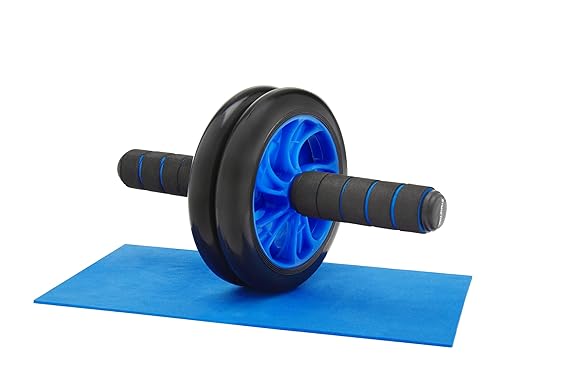
CORE TRAINING: Work the muscles in your stomach, shoulders, arms, back, and thighs with the easy-to-use ab rolling wheels.
Amazon Brand – Symactive Home Gym Dual Anti-Skid Wheel Ab Roller/Blaster for Abdominal Core Exercise for Men & Women (6 MM Safe Knee Mat, Foam Handles, Blue, Max Wt: 150 Kg)
Original price was: ₹900.00.₹369.00Current price is: ₹369.00.
Description
What is an Ab Roller Wheel
Wheel Ab Roller (also called ab wheel or abdominal roller) is a simple fitness tool designed primarily to strengthen the core. It consists of a wheel (or multiple wheels) with handles on either side. The user kneels or stands (depending on variation), grips the handles, and rolls forward and back, extending and retracting their torso, using core control. The movement is simple in concept but can be highly demanding in terms of strength, mobility, and stability.
Parts / Anatomy of the Ab Roller Wheel
To understand how it works best (and what makes different models vary), here are its main components:
| Part | Description | Importance |
|---|---|---|
| Wheel(s) | Could be a single wide wheel, dual wheels, or 3‑/4‑/triangular multi‑wheel setups. The wheel might have rubber or non‑slip tread. | Determines stability, smoothness of movement, grip on floor, and difficulty. More wheels = more stability. Wider wheel = better balance. |
| Axle / Shaft / Bar | The rod through the wheel(s) connecting the two handles; often made of steel or strong metal. | Needs to be strong and rigid to bear body weight without bending or wobbling. |
| Handles / Grips | Where you hold on. Often foam or rubber padded, sometimes textured or ergonomic, some curved. | Comfort, grip, avoiding slippage, wrist strain. Ergonomic grips help reduce fatigue and risk of injury. |
| Additional Support / Accessories | Some models include knee pads, pads for elbow‑support, non‑slip surfaces, timer, automatic rebound springs, or pads underneath. | These accessories improve comfort, protect vulnerable joints (knees, elbows), and sometimes aid safety or performance. |
Different models may trade off between stability, portability, cost, and challenge. For example, four‑wheel or dual‑wheel versions give more lateral stability; single‑wheel ones require more balance.
How it Works: Movement & Mechanics
The basic movement (often called a rollout) is:
-
Start from a kneeling position (or standing, for advanced versions), upright torso, hands on the handles, wheel in front.
-
Brace the core, keep back straight (avoid sagging or arching), and slowly roll the wheel forward, extending the body. The further you roll forward, the more core and hip flexor strength & control required.
-
Once you reach a limit (comfort, control, or ability), you roll back to start, using the core to reverse the motion (not just pulling with arms or momentum).
Key mechanical principles:
-
Tension & Control: You must maintain tension in the core muscles, glutes, and lower back to avoid sagging. The roller challenges the stabilizing muscles.
-
Progressive overload: Rolling further, doing more reps, going from knees to standing, or adding incline can increase difficulty.
-
Balance & stability: Because the wheel is a moving object, the core (including obliques and deep stabilizers) must work to keep torso alignment.
Target Muscles / What It Trains
An ab roller is not just for abs. Here are the main muscle groups worked:
-
Rectus abdominis: The “six‑pack” muscles; heavily involved in the extension and flexion movement.
-
Transverse abdominis: Deep core muscles; crucial for spine stabilization.
-
Obliques (internal & external): Control lateral (side) stability, rotation, and prevent twisting.
-
Erector spinae (lower back): Stabilize spine during the rollout, resist sagging.
-
Hip flexors: As you extend forward, the hip flexors stretch; on the return, they assist.
-
Shoulders, arms, chest: The arms/shoulders hold you in position; the chest may help to stabilize or as you pull back; sometimes engaged in more advanced variations.
-
Glutes and hamstrings (to some degree): For stability, especially maintaining a flat back, glutes help prevent lower back from going into extension.
Benefits of Using an Ab Roller
Here are the advantages of incorporating it into a fitness routine:
-
Core Strength & Stability: Strengthens both superficial (abs) and deep core muscles; better posture & spinal support.
-
Functional Fitness: Improves body control, helps in other exercises (like squats, deadlifts) by supporting better core stability.
-
Efficient & Compact: Small, cheap, takes little space; can give intense core workout without complex machinery.
-
Versatility: By changing positions (kneeling, standing, incline), speed, range, you can scale difficulty.
-
Full‑Body Engagement: While ab roller is core‑centric, many other body parts assist; helps in overall muscular coordination.
Limitations & Risks
It’s not all upside; there are some drawbacks and risks if used improperly:
-
Lower Back Strain / Injury: If the core isn’t tight, hips sag, or movement is uncontrolled, there’s risk of lumbar spine strain.
-
Shoulder Stress: Shoulders, especially anterior deltoids, can overwork; poor mobility or weak shoulders can get hurt.
-
Wrist / Elbow Discomfort: Especially in models without good grip or padded handles, or when leaning too heavily or over‑extending.
-
Requires Strength & Range of Motion: Beginners may not have enough core strength or shoulder flexibility to do full rollouts; trying full version too early can lead to injury.
How to Use an Ab Roller Safely: Technique & Progressions
Here are steps for safe, effective use, and progressions for beginners to advanced users.
Proper Technique
-
Warm up: Mobilize shoulders, thoracic spine, hips; activate core (planks, bird‑dogs etc.).
-
Starting Position: Kneel (or stand for advanced variants), hands on handles, wheel on floor in front of you, core engaged, back neutral (not arched or sagging).
-
Roll Out: Slowly roll the wheel forward, keeping arms straight (but not hyperextended), butt and glutes tight, core braced, breathing steady.
-
Limit: Only roll as far as you can maintain form — if lower back starts sagging or you lose control, stop there.
-
Return: Pull/push (depending on wheel direction) back using core, not momentum; exhale as you come back.
-
Repeat: Maintain control throughout reps; rest adequately between sets.
Progressions
| Level | Variation / Adjustment |
|---|---|
| Beginner | Rollouts from knees; short range (don’t extend fully); use wall or anchor to limit forward extension; maybe dual or multi‑wheel version for more stability. |
| Intermediate | Full extension from knees; roll further; slow tempo; pause at max extension; maybe use one arm (if advanced enough); incline surfaces. |
| Advanced | Rollouts from standing; add resistance; do explosive roll‑in; reverse direction; perform rollouts on unstable surface; integrate into complex core circuits. |
Safety Tips
-
Use knee pads to protect knees.
-
Make sure floor surface gives traction (non‑slip).
-
Don’t rush the movement; slow Wheel Ab Roller and controlled is better.
-
Listen to your body: if lower back pain, Wheel Ab Roller stop and regress.
-
Warm up well, especially shoulders and spine.
Types / Variations of Ab Roller Wheels
There are many different designs; here are Wheel Ab Roller some common variations:
-
Single‑wheel vs dual/multi‑wheel: Single‑wheel Wheel Ab Roller is more challenging (balance) but more compact; multi‑wheel gives more lateral stability.
-
Ultra‑wide wheels: Better stability Wheel Ab Roller especially for beginners.
-
Curved / Ergonomic Handles Wheel Ab Roller vs straight ones: For better grip, wrist angle comfort.
-
Automatic rebound / resistance springs in some models: Makes return easier (or harder) depending on spring.
-
Timer / accessories: Some newer ab wheel products include timer, elbow support pads, extra knee pads etc.
-
Folding or detachable wheels: For portability / storage.
What to Look for When Buying
If you’re considering getting one, here are criteria to check:
-
Wheel Width & Number of Wheels – Wheel Ab Rollerwider = more stable; multi‑wheels increase support.
-
Material & Build Quality – sturdy axle Wheel Ab Roller(steel), good wheel material (non‑slip, durable), handles comfortable.
-
Grip & Handle Comfort – padded handles, ergonomic design, sweat‑resistant.
-
Accessories – knee pad, elbow support etc. are a big plus.
-
Portability / Storage – detachable Wheel Ab Roller or folding options help.
-
Weight Capacity – ensure it Wheel Ab Roller supports your weight safely.
-
Budget vs Quality – cheap models may degrade: Wheel Ab Roller wheels wear out, grip becomes slippery, axle can wobble.
Examples of Features in Real Products (from Indian Market)
To give a practical feel, here are some features from actual Ab Roller products in India:
-
The Soulflex Ab Roller Wheel has an ultra‑wide wheel design for stability, non‑slip wheel, and ergonomic curved handles. Soulflex
-
The Dr Trust Abs Wheel Roller Wheel Ab Roller includes a high‑density knee mat, dual‑textured non‑slip wheel base, padded handles, and sturdy construction. Dr Trust
-
Multi‑wheel versions (3 wheels or 4 wheels) to provide better balance and support. Amazon India+2Flipkart+2
-
Compact and lightweight versions with good grip handles for home use. fitfix.in+2Flipkart+2
Sample Workout Plan Using Ab Roller
Here’s a sample plan, gradually increasing intensity:
| Day | Set / Reps | Variation / Tips |
|---|---|---|
| Week 1‑2 (Beginner) | 3 sets × 5‑8 reps | Kneeling rollouts, short extension, focus on form; rest 1‑2 min between sets. Use knee pad. |
| Week 3‑4 (Intermediate) | 3 sets × 8‑12 reps | Full extension from knees; slower tempo; pause at max extension. Maybe dual‑wheel for more stability. |
| Week 5‑6 (Advanced) | 4 sets × 8‑10 reps | Standing rollouts or incline; one‑arm rollouts; integrate into circuits; reduced rest. |
Be sure to combine with other core, back, hip, glute work for balance.
Common Mistakes & How to Avoid Them
-
Allowing lower back to sag — always Wheel Ab Roller keep core tight, glutes engaged to prevent drooping of the hips.
-
Over‑extending too soon — gradually increase range of motion; don’t try standing rollouts if core/back aren’t ready.
-
Using momentum instead of control — roll slowly, control both forward and backward phases.
-
Holding breath — keep breathing, Wheel Ab Roller exhale on exertion (rolling back) or as feels natural.
-
Poor shoulder or wrist alignment — keep shoulders stable; wrists aligned; choose handles that don’t strain the joints.
Who Should / Should Not Use It
Who Should
-
Anyone wanting stronger core, better posture, better spine stability.
-
People doing other heavy lifts (deadlift, squat) Wheel Ab Roller who want better core support.
-
Anyone wanting compact, low‑cost equipment for home workouts.
Who Should Be Cautious / Avoid
-
Those with existing lower back pain, spinal issues — unless under guidance / after improving core and mobility.
-
Individuals with shoulder pain or weak shoulders.
-
People with wrist problems (narrow or hard handles, no padding increase stress).
-
Beginners without prior core strengthening (planks, bird‑dogs etc.) should build up first.
Effectiveness & Comparisons
-
Many fitness experts regard the ab wheel as Wheel Ab Roller one of the most effective core strengtheners because it works not only the visible abs but the deeper stabilizers and engages many muscle groups. SELF
-
Compared to crunches or sit‑ups, the ab roller roller Wheel Ab Roller provides a longer lever arm (farther from the body), which increases demand on muscles.
-
Compared to machines or weighted cable exercises, Wheel Ab Roller the ab wheel is minimal but demands great body control; ideal for complementing other exercises.
Summary
To sum up:
-
The Ab Roller Wheel is a simple, effective tool for core Wheel Ab Roller strengthening.
-
Its effectiveness depends heavily on proper form, steady control, and progressive overload.
-
There are many designs and accessories; the right choice depends on your strength, experience level, and comfort.
-
Used well, it improves core strength, posture, stability, and functional fitness; used poorly, it can lead to strain, especially in lower back or shoulders.
Reviews
There are no reviews yet.