
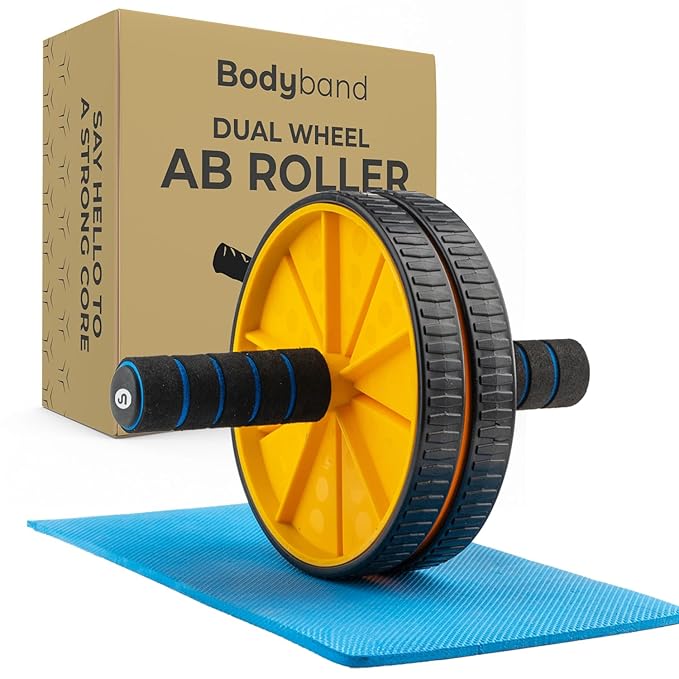
COMPREHENSIVE CORE STRENGTHENING: Elevate your core workout routine with our Abroller, a fitness essential designed for comprehensive core strengthening. This ab wheel roller for men ergonomic design ensures proper form and targets key muscle groups, offering an effective and focused workout for your abdominal region. As an added feature, this ab roller wheel includes a knee mat for comfortable knee placement during exercises, ensuring a holistic approach to your fitness journey.
Bodyband Abs Roller for Men & Women Stomach Abs Roller Wheel for Home Workout, Gym Ab Roller for Men Abs Workout Equipment for Abdominal Ab Roller Home Exercise Equipment With Knee Mat -Yellow Black
Original price was: ₹499.00.₹199.00Current price is: ₹199.00.
Description
Abs Roller:
The Ultimate Guide to Core Mastery
Table of Contents
-
What Is an Abs Roller?
-
Muscles Worked by the Abs Roller
-
Benefits of Using an Abs Roller
-
Who Should Use (or Avoid) the Abs Roller
-
How to Use the Abs Roller: Technique & Variations
-
Sample Workout Plans / Routines
-
Progressing Safely: Beginner → Intermediate → Advanced
-
Common Mistakes & How to Fix Them
-
Safety, Injury Prevention & Recovery
-
Choosing the Right Abs Roller
-
Cleaning, Maintenance, and Longevity
-
Abs Roller Myths vs Facts
-
Conclusion
1. What Is an Abs Roller?
An abs roller, sometimes called an ab wheel or abdominal wheel, is a simple piece of fitness equipment: a wheel (or wheels) with handles on either side. It rolls along the floor while you hold the handles, usually from a kneeling position or more advanced from a standing or plank‐based stance. By rolling out and then returning, you challenge your core muscles, especially in resisting extension (preventing your lower back from sagging or arching), stabilizing your spine, and controlling movement.
The mechanics are straightforward, but proper use is essential. The device is minimalist in design yet offers deep training potential because it demands coordination, strength, flexibility, and stability.
2. Muscles Worked by the Abs Roller
Using the abs roller recruits many muscles, not just the superficial “six‑pack” (rectus abdominis). Knowing what’s involved helps you understand its full potential and avoid overuse or imbalance.
| Primary Muscle Group | Role During Rollout / Return |
|---|---|
| Rectus abdominis | Main mover managing spinal flexion; controls movement during roll out and roll back. |
| Transverse abdominis | Deep core stabilizer; keeps the abdominal cavity tight, stabilizes lumbar spine during the motion. |
| Obliques (internal & external) | Assist in stabilization, especially if rollouts are angled or asymmetrical; help resist twisting and side sag. |
| Hip flexors | Are engaged, particularly during extension / rolling out; but over‑reliance can cause strain if core is weak. |
| Lower back muscles (erector spinae) | Eccentrically control extension to avoid sagging of lumbar spine; assist in the return. |
| Shoulders, lats, triceps | Hold your upper body position; when rolling, shoulders support and stabilize, latissimus dorsi helps in returning the wheel. |
| Glutes | Help stabilize hips; squeezing them helps avoid sagging; active during returns. |
Also, you get benefits in joint stability (shoulder, wrist), and improved balance. Because of the full‑body engagement required for control, even though the roller seems “just for abs,” many auxiliary muscles are taxed.
3. Benefits of Using an Abs Roller
Here are the major advantages of incorporating the abs roller into your fitness routine, supported by research and experience:
3.1 Superior Core Strength & Stability
The abs roller forces you to resist spinal extension, which is a powerful way to build core strength. Rather than just bending or crunching, you’re working throughout the full motion of extension and return, integrating deep core muscles. Livestrong+2Well Fit Insider+2
3.2 Improved Posture & Spinal Health
Because the roller helps you maintain a neutral spine, strengthens the muscles around the spine (both front and back), and teaches proper bracing, it can help reduce lower back pain and improve posture. Livestrong+2Byrdie+2
3.3 Engages Multiple Muscle Groups (Functional Strength)
You’re not just training abs; you’re also working shoulders, lats, arms, glutes, hip flexors. This leads to better functional strength—that is, strength useful in everyday life and sport. Movements like carrying, lifting, bending, and even running benefit from a well‑trained core. Livestrong+2Well Fit Insider+2
3.4 Increased Flexibility & Range of Motion
Rolling out stretches the muscles in the core, hip flexors, shoulders, and possibly back extensors. Over time, this can improve flexibility in those areas (especially if rollouts are done with control and gradual progression). Livestrong+1
3.5 Calorie Burn and Fat Loss Support
Since the abs roller is intense—for core training plus secondary muscles—it increases energy expenditure. Though alone it won’t cause major fat loss, combined with proper diet and full‑body training, it helps. Livestrong+1
3.6 Compact, Affordable Equipment
It’s inexpensive, simple, and takes little space. Great for home gyms, small apartments, or travel. Healthshots+2Royalblaze – My WordPress Blog+2
4. Who Should Use (or Avoid) the Abs Roller
While the abs roller is powerful, it’s not for everyone. Knowing whether you’re ready, and how to approach it safely, is key.
4.1 Good Candidates
-
People with at least some baseline core strength
-
Those looking for core improvement, posture, and functional strength
-
Individuals with experience in basic core exercises (planks, bird‑dogs, etc.)
-
Athletes, fitness enthusiasts wanting a challenging tool
4.2 Who Should Be Cautious or Avoid
-
Anyone with current lower back injuries, herniated discs, or lumbar spine issues — may exacerbate problems. Burnlab.Co+2Byrdie+2
-
Severe wrist, shoulder injuries (since these joints support body weight during rollouts)
-
Beginners with very weak core or poor stability — must build up slowly. Gym.com+1
-
People not cleared by a doctor/physio if recovering from abdominal surgery or major injury.
5. How to Use the Abs Roller: Technique & Variations
Getting technique right is critical. It’s better to do fewer reps correctly than many reps poorly.
5.1 Basic Rollout (from Knees)
How to do it:
-
Start on hands and knees, with the abs roller wheel in front of you. Knees on a mat if possible.
-
Grasp the handles firmly. Keep hands shoulder‑width apart.
-
Engage core: pull belly button toward spine, squeeze glutes, brace.
-
Slowly roll forward, extending body, maintaining a straight lumbar spine, not letting lower back sag. Go as far as you can while staying under control.
-
Pause or hold briefly if you reach the far point (without compromising form).
-
Use core strength to pull / roll back toward knees, returning to starting position.
-
Breathe: inhale as you roll out, exhale as you roll back.
Tips:
-
Don’t rush. The slow controlled motion is more effective. Simple Fitness Hub+2Livestrong+2
-
Keep your neck neutral; don’t lift or drop your head too much.
5.2 Variations
Once you have the basic rollout under control, you can progress or add challenge through variations.
| Variation | What’s Changed / More Challenging | Muscles Emphasized |
|---|---|---|
| Negative Rollout | Roll out as far as possible, then lower to floor or collapse from thighs, then return with control. Helps build strength eccentrically. Bicycling | Core, especially control during return; helps build tolerance. |
| Standing Rollout | From standing, roll down toward the floor as far as flexibility / strength allows. Much more advanced. | Full core, shoulders, lats, hip flexors. |
| Oblique/A‑angled Rollouts | Roll out slightly to one side, come back, then alternate. Targets obliques more. centr.com | Obliques, lats, core stability. |
| Plank + Roller Combo | Use roller in front, hold plank then perform small rollouts. Adds isometric and dynamic mix. | Core endurance + strength. |
| Knee‑Tucks with Foot Straps | If roller has straps or accessory to attach feet, you can do knee tucks from plank. Greatist | Lower abs, hip flexors, more dynamic control. |
6. Sample Workout Plans / Routines
Here are routines you might follow depending on your level and goal.
6.1 Beginner Routine
Focus: learning form, building base strength.
-
Warm‑up: 5 minutes light cardio + dynamic stretches
-
Basic Rollout (knees): 3 sets x 5‑8 reps
-
Plank: 2 x 30 seconds
-
Bird‑dog or Dead Bug: 2 x 8‑10 each side
-
Cool down: stretching focusing on abs, back, hip flexors
Frequency: 2‑3 times per week with rest days in between core days.
6.2 Intermediate Routine
Focus: increasing intensity, adding variations.
-
Warm‑up
-
Basic Rollout: 3 x 8‑10 reps
-
Negative Rollout: 2 x 5 reps
-
Oblique Rollouts / Angled Rollouts: 2 x 6 each side
-
Plank Roller Combo: 2 x 30‑45 seconds
-
Cool down
Frequency: 3 times per week.
6.3 Advanced & Lean / Definition Focus
Focus: Max challenge, volume, full range.
-
Warm‑up
-
Standing Rollouts or close to floor: 3 x 5‑8
-
Negative + Pause at full extension: 2 x 5
-
Oblique Rollouts / A‑angled: 2 x 8 each side
-
Integrated circuits (roller + push ups + core)
-
Cool down
Frequency: 3‑4 times per week depending on recovery.
7. Progressing Safely: Beginner → Intermediate → Advanced
To minimize injury risk and maximize gains, progression is important.
-
Start Slow: begin with partial rollouts or limited range of motion, from knees.
-
Focus on Quality over Quantity: ensure your form is spot on, even if you can only do 1‑3 reps. Simple Fitness Hub+1
-
Use Regressions When Needed: knees version, negative only, or rolling out against a wall for limited depth.
-
Watch for Signs of Overreach: lower back pain, sagging spine, difficulty controlling even small distances. If those occur, reduce range or regress.
-
Allow Recovery: core muscles need rest; do not overdo daily unless you target endurance and have strong recovery.
-
Supplement with Other Core Work: planks, side‑planks, anti‑rotation work, etc., to build a balanced core.
8. Common Mistakes & How to Fix Them
Even small errors in technique can reduce benefits or cause injury. Here are frequent mistakes and tips to correct them:
| Mistake | Consequence / Risk | Correction |
|---|---|---|
| Allowing lower back to arch (sagging) | Strain on lumbar spine; risk of injury | Brace core; engage glutes; limit roll out until core is strong |
| Using hip flexors too much / Pushing with arms | Reduced core activation; overuse of wrong muscles | Focus on arms straight; pull with abs; keep hips stable |
| Rolling too fast / bouncing back | Momentum, less control, risk of injury | Slow, controlled movement; pause at full extension |
| Lifting the head / looking up (neck extension) | Neck strain; misalignment | Keep neck neutral; chin slightly tucked |
| Too many reps too soon | Overuse, soreness, risk of fatigue, loss of form | Start with low reps; increase gradually |
| Not warming up or cooling down | Tight muscles, increased risk of strain | Incorporate dynamic warm‑ups and static stretching post‑workout |
9. Safety, Injury Prevention & Recovery
9.1 Warm-Up
Always prepare your core, hip flexors, shoulders, and wrists. Dynamic movements like cat‑cow, hip hinge drills, shoulder rotations, light plank variations.
9.2 Using Knee Pads or Mat
To protect knees, use padding. Also helps prevent slipping.
9.3 Listening to Your Body
Pain vs discomfort: discomfort is expected; sharp pain is not. If lower back or shoulder pain, stop and assess form. If persists, consult a professional.
9.4 Recovering
-
Stretch post‑workout: focus on hip flexors, spine, shoulders.
-
Use foam roller or mobility work.
-
Allow rest days.
-
Ensure proper nutrition & hydration to support muscle recovery.
9.5 When to Avoid or Modify
-
During acute injury
-
If you feel instability in core or joints
-
If you have specific medical conditions (hernia, spinal issues, etc.) — get medical clearance.
10. Choosing the Right Abs Roller
Not all abs rollers are equal. Here’s what to look for when buying one.
10.1 Wheel Design
-
Single wheel vs Dual‑wheel: Dual wheels are generally more stable, less wobble. Healthshots+1
-
Wheel width: Wider wheel gives more stability; narrow wheel allows deeper rollouts but needs better balance.
10.2 Handle Grip & Comfort
-
Non‑slip handles, padded where needed
-
Good grip to avoid slipping, especially during sweaty workouts
10.3 Material Quality
Strong frame (metal/steel core), robust handle, durable wheel (rubber or non‑slip material)
10.4 Accessories
-
Knee pad or mat
-
Rebound mechanism (some rollers assist return) but be cautious if relying too much on it.
-
Foot straps or attachments (if doing advanced moves)
10.5 Price & Warranty
Balance cost vs reliability; read reviews. A roller that fails (wheel misaligns, handles break) can be dangerous.
11. Cleaning, Maintenance, and Longevity
To get the most life out of your abs roller:
-
Wipe down handles, wheel after each use (especially with sweat)
-
Keep roller dry (rust prevention on metal parts)
-
Check tightness of handles / wheel axle periodically
-
Store in dry place, avoid leaving under direct sun or moisture
-
Replace parts (wheel, grip) if worn or cracked
12. Abs Roller Myths vs Facts
Here are a few common beliefs or concerns, and what evidence / expert opinion says:
| Myth | Reality / Fact |
|---|---|
| “Ab roller is only for washboard six‑pack abs” | It builds functional core strength, stability, posture—not just visible abs. |
| “More reps = faster results” | Quality over quantity; bad reps degrade form and may lead to injury. |
| “You’ll get strong abs overnight with roller” | Needs consistent work over weeks; diet, rest, consistency matter. |
| “Ab roller damages your back if you use it at all” | It can, if form is poor or if you have existing injuries; but when used correctly and gradually, it helps protect the back. |
| “You must be very fit to even try the roller” | Regressions (knees, partial rollouts) allow beginners to build up safely. |
13. Conclusion
The abs roller is one of the most effective and efficient tools you can add to your fitness arsenal for core strength, posture, and overall functional fitness. It offers more benefits than many traditional ab moves—if you use it correctly. Start slow, focus on form, progress gradually, and incorporate variations to avoid plateaus.
Whether you’re a beginner just learning core control, or advanced wanting to push your limits, the abs roller has something to offer. With consistent, disciplined work, you’ll build a strong, resilient core, better posture, fewer injuries, and more confidence in your movements.
Reviews
There are no reviews yet.